
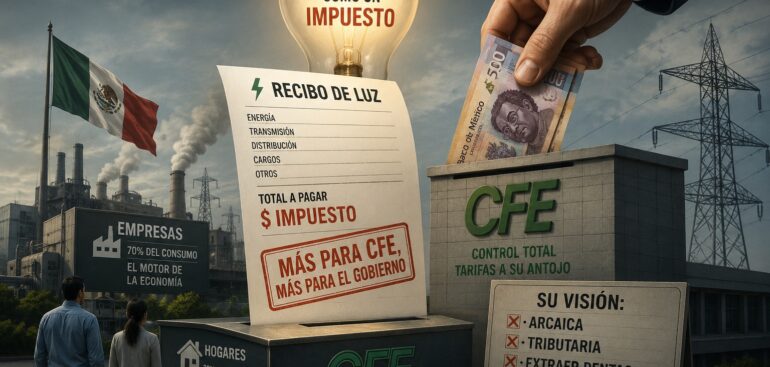
The electric reform presented by the president and that will be discussed this Sunday considers electricity not as a means to generate wealth nor well-being. At the heart of the declarations and intentions lies a painful truth regarding the origin and objectives of the reform: that electricity be a tax paid by Mexican companies and households.
There is a great conceptual confusion that permeates from equating the history of the national electric sector with that of oil, or even mines because of lithium. At the heart of the confusion, a 2.0 nationalization of electricity in the country is intended, but it is forgotten that electricity by itself is not wealth, but rather it is a means that would allow wealth to be generated if used in the correct way.
I reiterate, electricity by itself does not generate wealth, since we cannot generate it, bottle it and export it so that other countries buy it and profits are obtained from its exploitation. Nor can we use it to infinitely increase our well-being, that is, if price did not matter, having six refrigerators turned on does not improve our quality of life.
To the point of absurdity, neither can we use electricity as a force field to avoid invasions and protect national sovereignty from external aggressions. Much less give electricity to families so that they may feed themselves if food is lacking. We cannot use electricity as money, nor save electricity for the future or to relieve economic recessions.
“The vision is not only archaic, but, deep down, it is tributary.”
Electricity is, then, a means, not an end in itself. It is a means that allows us to improve the conditions of households, the lighting of streets, the mobilization of people and the productive activation of factories. Electricity is a means to mobilize and drive the economy; as a country, having an abundance of electricity means that you can offer it to companies so that they generate productive processes.
In Mexico, around 70% of the country’s electric energy is consumed by companies, from small businesses to large industries, and only 25% of consumption is attributable to households. This means that it is of no use to us to have an abundance of electricity if it is not used to strengthen the economy. That is, if tomorrow all companies stop consuming, Mexican households do not benefit; on the contrary, the economy is harmed.
If a country has an abundance of clean and cheap energy, it immediately positions itself as one of the most attractive countries to invest in and that is what generates wealth, not electricity flowing through the networks without being able to be used because companies abandon and stop investing.
The objective of the electric reform is clear and has been reiterated by its defenders on multiple occasions: that industries, businesses and households pay more for electricity, that they pay more to CFE and that CFE obtains control to set the tariffs it wants to whomever it wants and that each and every one of the load centers only buy electric energy from CFE.
The vision is not only archaic, but, deep down, it is tributary, because instead of seeing electricity as a good or service whose purpose is to enable satisfiers and drive economic dynamism, it is only seen as a tax to extract rents from the companies and households that consume the energy. It is simply and plainly about obtaining more cash flow for CFE.
This article was originally published by Energía a Debate.
Date: April 17, 2022
Link: https://energiaadebate.com/la-electricidad-como-un-impuesto/ [Online]