
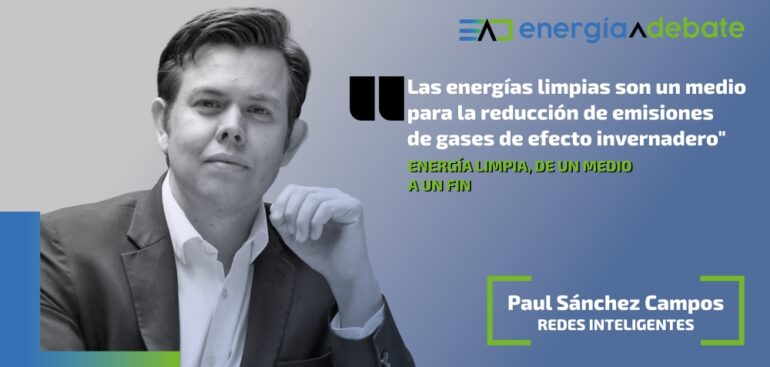
Clean Energies, from a Means to an End

Regarding the debacle generated by the regulatory changes of the Energy Regulatory Commission related to the measurement of energies in the national electric system, I believe it is important to remember that increasing clean energies in the energy matrix of our country is not an end in itself and the correct indicator is not the percentage of clean energies that the matrix has.

Clean energies are a means for the reduction of greenhouse gas emissions, for the decarbonization of the energy matrix and of the emissions intensity of the national electric system. The famous percentage of 35% is an indicator that was calculated with the purpose of determining how much clean energy proportional to the total was necessary to reduce a given volume of emissions.

“Clean energies are a means for the reduction of greenhouse gas emissions.”

But let us go to the beginning. After the signing, ratification and entry into force of the Paris Agreement, the countries took on as a task to establish the nationally determined contributions. Within this framework, Mexico established a series of commitments for the 2020-2030 period within which the following stands out: “By 2024, 35% clean energy will be generated and by 2030, 43%, including renewable energy, cogeneration with natural gas and thermoelectric plants with CO2 capture.”

At that time, with data from 2013, Mexico’s greenhouse gas emissions for electric generation were 127 million tons of CO2 equivalent, so it was determined that by having clean energy generation of 35% by 2024, then the emissions that were linearly calculated could reach 177 million tons and decrease to around 130 million tons of CO2 equivalent.

The regulatory changes published by the Energy Regulatory Commission at the end of the month of May, which modified the methodologies for the measurement of clean energies to consider as clean energy that electricity produced by the gas steam of combined cycle plants that use natural gas, as long as it does not use additional fuel, derived in the update of the National Electric System Development Program (PRODESEN) 2023-2037.

In that sense, and according to said document, generation in 2022 presented a total of 31.2% clean energies, an amount that was obtained based on the methodological modifications of Agreement No. A/018/2023 of the CRE, published in the DOF on May 26, 2023. That is, because of the change in calculation from 2021 to 2022, the newly catalogued non-renewable clean energy increased by 7,502.1 GWh.

This recategorization, however, does a poor favor to the reduction of international commitments, since according to SEMARNAT data, from 2021 to 2022 the emissions factor of the National Electric System went from 0.423 tons per MWh to 0.435 tons per MWh. That is, more clean energy by reclassification with more emissions in the system.

If we consider the same information from PRODESEN 2023-2037, we can multiply the total generation of the system by the emissions intensity to obtain the absolute, that is, in 2021 when 328,598 GWh were generated, 138,997 kilo-tons of CO2 equivalent (ktCO2eq) would have been produced and in 2022 with 340,713 GWh, 148,210 ktCO2eq were emitted into the atmosphere. There is the paradox, since our emissions increased by almost 10,000 tons, at the same time that the participation rate of clean energy generation increased.

The moral of this story is that it is of no use to us to see the participation of clean energies as an end, since in themselves they should be a means for the reduction of greenhouse gas emissions. That is, even if tomorrow all gas were declared clean and 80% of the country’s energy, by decree, were clean, the reality would be that, ultimately, there are no emissions decreases, therefore, the country’s progress in fulfilling its climate objectives would continue to be highly insufficient.


This article was originally published by Energía a Debate.
Date: June 12, 2023
Link: https://energiaadebate.com/energias-limpias-de-un-medio-a-un-fin/ [Online]

OPEC+ Cuts Again

This Sunday the news was spread that OPEC+ is planning a new voluntary cut led by Saudi Arabia that by itself would reduce 500,000 barrels per day. The members of OPEC and their allies could reduce between 1.1 and 1.6 million barrels per day of crude in the world market, which depends on Russia contributing another 500,000 barrels per day to the reduction. In any case, the cut would enter into force starting in May and would extend throughout all that remains of 2023.

Of course this is not a coincidence. In the midst of the financial chaos caused by the inflationary escalation, the continuous rise of the reference rate and the blow to banking institutions, it is not the best moment for energy prices to come back on the offensive. But it is clear that the surprise cut is directed at the United States for a couple of reasons particularly.

“It is clear that the surprise cut is directed at the United States.”

On the one hand, in October of last year the United States promised Saudi Arabia that it would not let oil prices collapse and that, once prices touched $75 dollars per barrel in the Brent reference, the government of the United States would begin to fill its strategic reserve to keep the price stable.

However, when the price of Brent fell below the mark in mid-March, the Biden government showed little interest in beginning the purchase of oil to refill the strategic reserve and even declared that perhaps, toward the end of 2023, they could begin with the purchase to observe the behavior of global markets derived from the recent financial shocks.

On the other hand, just last week the United States Energy Information Agency published that in 2022 the United States broke a record of crude exports, reaching 3.6 million barrels per day, which represented an increase of 22% compared with 2021.

Faced with greater production of American oil in the world and with prices falling in comparison with the previous year, it seemed like a good moment to begin filling the strategic reserve of the United States. This would allow reducing the circulating crude and stopping the fall of international prices.

These two events could have had political implications, or that is what is rumored in the circles that follow the issue. That Biden did not quickly fulfill his word to maintain the international price of oil contributes to the deterioration of relations between the two nations.

For now, the price of oil in the main references has risen around five dollars per barrel after the announcement. It is too soon to know whether this price will be maintained in the future or how the United States will respond or, even, whether the countries, including Russia, comply with the voluntary reduction, but what is a fact is that this occurs at a complicated moment due to global inflationary pressure.


This article was originally published by Energía a Debate.
Date: April 3, 2023
Link: https://energiaadebate.com/la-opep-recorta-de-nuevo/ [Online]

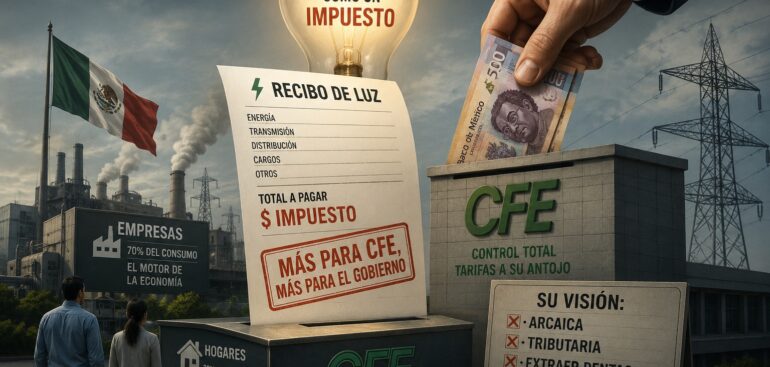
Electricity as a Tax

The electric reform presented by the president and that will be discussed this Sunday considers electricity not as a means to generate wealth nor well-being. At the heart of the declarations and intentions lies a painful truth regarding the origin and objectives of the reform: that electricity be a tax paid by Mexican companies and households.

There is a great conceptual confusion that permeates from equating the history of the national electric sector with that of oil, or even mines because of lithium. At the heart of the confusion, a 2.0 nationalization of electricity in the country is intended, but it is forgotten that electricity by itself is not wealth, but rather it is a means that would allow wealth to be generated if used in the correct way.

I reiterate, electricity by itself does not generate wealth, since we cannot generate it, bottle it and export it so that other countries buy it and profits are obtained from its exploitation. Nor can we use it to infinitely increase our well-being, that is, if price did not matter, having six refrigerators turned on does not improve our quality of life.

To the point of absurdity, neither can we use electricity as a force field to avoid invasions and protect national sovereignty from external aggressions. Much less give electricity to families so that they may feed themselves if food is lacking. We cannot use electricity as money, nor save electricity for the future or to relieve economic recessions.

“The vision is not only archaic, but, deep down, it is tributary.”

Electricity is, then, a means, not an end in itself. It is a means that allows us to improve the conditions of households, the lighting of streets, the mobilization of people and the productive activation of factories. Electricity is a means to mobilize and drive the economy; as a country, having an abundance of electricity means that you can offer it to companies so that they generate productive processes.

In Mexico, around 70% of the country’s electric energy is consumed by companies, from small businesses to large industries, and only 25% of consumption is attributable to households. This means that it is of no use to us to have an abundance of electricity if it is not used to strengthen the economy. That is, if tomorrow all companies stop consuming, Mexican households do not benefit; on the contrary, the economy is harmed.

If a country has an abundance of clean and cheap energy, it immediately positions itself as one of the most attractive countries to invest in and that is what generates wealth, not electricity flowing through the networks without being able to be used because companies abandon and stop investing.

The objective of the electric reform is clear and has been reiterated by its defenders on multiple occasions: that industries, businesses and households pay more for electricity, that they pay more to CFE and that CFE obtains control to set the tariffs it wants to whomever it wants and that each and every one of the load centers only buy electric energy from CFE.

The vision is not only archaic, but, deep down, it is tributary, because instead of seeing electricity as a good or service whose purpose is to enable satisfiers and drive economic dynamism, it is only seen as a tax to extract rents from the companies and households that consume the energy. It is simply and plainly about obtaining more cash flow for CFE.


This article was originally published by Energía a Debate.
Date: April 17, 2022
Link: https://energiaadebate.com/la-electricidad-como-un-impuesto/ [Online]