
It is assumed that the more calories you consume,
the more energy you will have, but that is not the case.
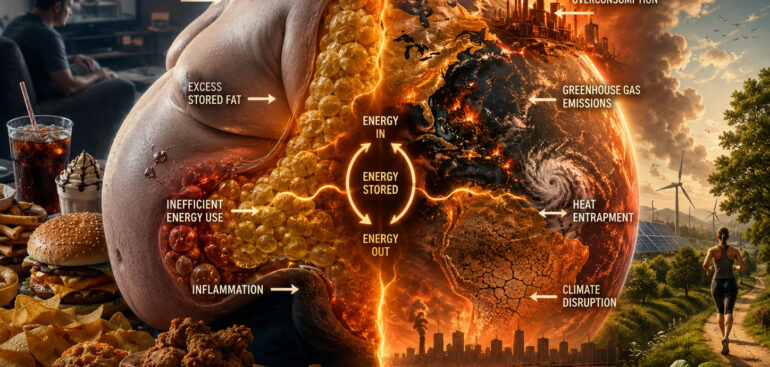
Obesity and climate change have certain parallelisms seen from the management of energy. In our times, where fossil fuels dominate the energy scene, the consumption of these sources has consequences, as we have already explored, in the emission of greenhouse gases, global warming and climate change. Now let us think of our bodies as energy systems and we will be able to observe these parallelisms.
The exploitation of fossil sources of energy is recent when we see the long course of the history of humanity, and it unleashed an increase in the quantity supplied and demanded by the economies in the world. We can think the same about the energy available to human beings; although today we can get large amounts of fats and sugars in any convenience store, before it was a matter of life or death.
Imagine societies before the Neolithic revolution, before the emergence of agriculture. Getting protein, fats and carbohydrates was not as simple as doing the grocery shopping online, but rather required dedicating time and effort to hunting and gathering, and caloric scarcity predominated. The fact that our body accumulates fat is because, in a natural state, it is very difficult to obtain and, therefore, it was important that our bodies store it, which is not very distant from the greenhouse process that allows storing the heat that our Earth receives.
By increasing the amount of food available in modern societies, today we face caloric excess that generates changes in our body and that, if it is not observed adequately, can generate overweight and obesity, which, in most cases, are synonymous with poor energy management in our organism.
Obesity has become the fifth risk factor of death in the world, since it is associated with the increase of cardiovascular, gastrointestinal, renal, obstetric, musculoskeletal, neurological, respiratory and even psychological diseases.
For their part, greenhouse gases produce an effect on the global climate, generating a significant increase in the temperature of the Earth and, this global warming, has a consequence: climate change. This forces societies to endure the consequences of a more adverse climate, the loss of microecosystems, such as some islands in the Pacific.
In such a way that more modern economies make a call to understand the impact of energy consumption on our planet in order to dissuade the trend and others create instruments such as green taxes or carbon bonds with the purpose of paying for emissions and their consequences.
In the same way, to keep the excess of calories in our bodies at bay, we have to reduce our consumption through diets that imply energy efficiency or, in some cases, pay for a gym to exercise or invest time to go out running. Even governments are beginning to adopt policies such as labeling to make consumers aware of which foods have excess fats.
So, just as climate change is associated with the abundance of fossil and cheap energy of our times that sustains the demand of economies, the obesity of our times is associated with the abundance of cheap calories that sustain the demand of our lifestyles. Nevertheless, unlike the energy sector that seeks to solve this problem through the adoption of renewable energies, a similar solution is not envisioned for us, unless we can live only from the sun and a balanced diet.
This article was originally published by Business Insider México.
Date: September 30, 2020
Original Link: https://businessinsider.mx/obesidad-cambio-climatico-paul-alejandro-sanchez-opinion-energia-circular/ [offline]
Archived Link: https://web.archive.org/web/20210515135209/https://businessinsider.mx/obesidad-cambio-climatico-paul-alejandro-sanchez-opinion-energia-circular/ [Archived]