
Be Careful with Energy Consumption


A common concern in times of confinement due to the Covid-19 pandemic is that suddenly CFE has raised energy prices. Although in previous months an X amount equivalent to energy consumption was paid, this has tripled and in some cases quadrupled, without the quantity consumed having increased proportionally. But, I am sorry to disappoint you, on this occasion it is not CFE’s fault, but rather ignorance of the tariff model and the consumption of our homes.

In Mexico the electric tariff of domestic users is controlled, this means that, even if there were a provider different from CFE, it would charge us practically the same. The energy reform sought to open the electric market but not all users have the opportunity to choose their supplier; only large industrial users or large commercial chains. These are called qualified users.

You and I, domestic users, enter into the second category, basic users. The idea is that there would be a type of user with a controlled and flat tariff so that they would always pay the same in their electricity bill and that, eventually, they could change provider by becoming qualified users or be represented by a load aggregator.

The idea of this is that we could play with our consumption and, in some cases, pay less than the controlled or protection tariff. How? For example, if I know that I will leave the city for two weeks, I know that I can pay a lower amount of energy; if I charge my cellphone and computer in the hours of lower demand, my consumption can be lower.

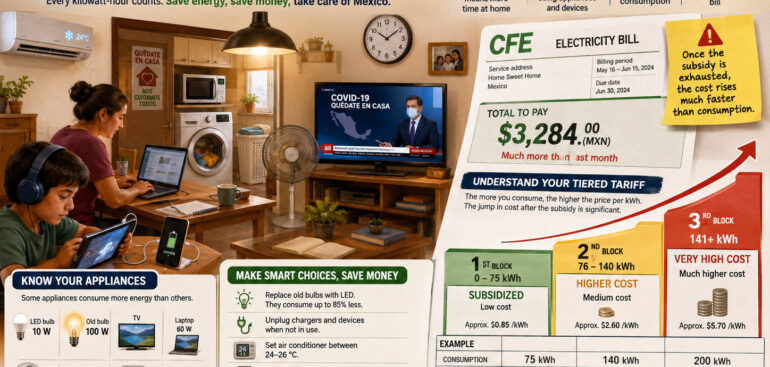
But this that I am telling you is, precisely, the reason behind why many people complain today about exorbitant energy prices. In Mexico, the tariff is tiered, this means that the kWh you consume in the first tier are much cheaper than those of the second tier and those of the third tier, much, but much, more expensive than those of the second tier.

This means that if before you consumed 75 kWh of energy per month, but you and your family spent time away, at school, the office, the cinema or the gym, a relatively low bill always arrived. However, in Mexico City, for example, each additional kWh after 75 costs twice as much as the first 75. In turn, each additional kWh after 140 kWh will cost three times more than the first 75.

By spending more time at home, energy consumption has grown.

In times of confinement, then, people spend more time at home, with the television on, the computer, the lights, the microwave oven; the washing machine, the heating or the air conditioning. The average consumption of households has doubled and this implies that they pay two or three times more because the level of subsidy provided by the State is exhausted.

What can we do? Know your consumption patterns and your appliances. For example, a baby bottle sterilizer consumes 750 W. This means that, using it 15 minutes twice a day in a month, you will consume a little more than 11 kWh —15% of the subsidized tariff in Mexico City. A television consumes 100 W, so having it on 12 hours a day would represent 36 kWh per month, half of your electric subsidy in Mexico City. By the way, if you have any normal 100 W bulb, it is spending the same as an LED TV. What are you waiting for? Change it.

For this reason, in times of pandemic, it is most likely that your consumption has increased and your electric bill comes higher. So be careful with consumption because you could move to the feared Domestic High Consumption tariff, of which I will tell you on another occasion.


This article was originally published by Business Insider México.
Date: October 21, 2020
Original Link: https://businessinsider.mx/cuidado-con-el-consumo-de-energia/ [offline]
Archived Link: https://web.archive.org/web/20240804051440/https://businessinsider.mx/cuidado-con-el-consumo-de-energia/ [Archived]
What Happened to Nuclear?


“The next energy miracle is nuclear energy”

– Bill Gates

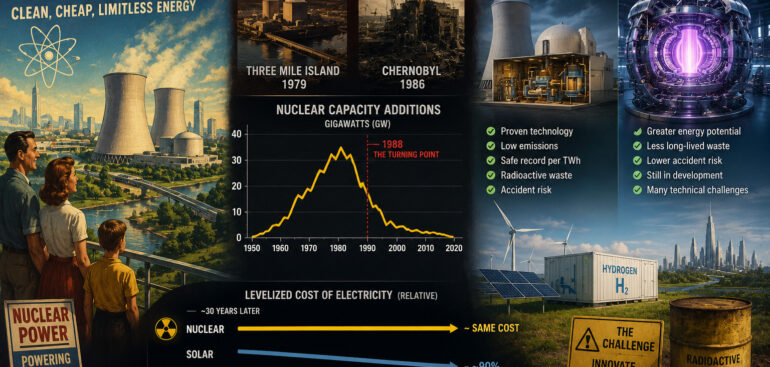
Back in the 1950s, nuclear energy was the promise of a bright future based on cheap and non-polluting energy. But the dream was cut short, mainly because of the bad press derived from catastrophic events such as Three Mile Island in the United States in 1979 and Chernobyl, in Soviet Ukraine in 1986.

Despite this, nuclear plants maintain the lowest rate of deaths and greenhouse gas emissions per energy generated among thermal technologies. That is to say that generation with coal, oil, natural gas and even hydroelectric plants have caused more accidents and deaths per unit of energy generated.

The nuclear boom occurred between the 1950s and 1980s and practically stopped in 1988 only to decrease in the 2010s. In comparison, while the costs of renewable energies have decreased at dramatic speeds, more proven technologies such as combined cycle turbines or internal combustion engines have also improved their costs and efficiencies. The above mainly because innovation and technological development, as well as strong competition, have not stopped.

However, for nuclear power plants it has been 30 years and the leveled costs have remained practically at the same levels because the memory of nuclear accidents is there. And as the years passed, the technological development of nuclear plants stagnated.

Now then, it is worth pointing out that when we talk about nuclear plants, in general, there are two ways to generate electricity: atomic fission and atomic fusion. The first is the only one that has been developed commercially and it is of which we have been talking up to this point. The second, for its part, remains in development in the international community and represents the possibility of a second wind for nuclear power plants.

Nuclear fission is the generation of a massive amount of energy due to the division of an atom. The most common nuclear fuels are the isotopes uranium-235 and plutonium-239. In a nuclear plant, the kinetic energy released by these materials is converted into heat that heats a fluid, normally water, which becomes heat and moves a turbine that produces the energy.

Nuclear fusion, for its part, is the inverse process. A great amount of energy is generated by the union of two or more atomic nuclei to form a different atomic nucleus or other subatomic particles. Fusion reactions have much greater energy density than fission reactions and with this they can produce electricity with the same principle as fission.

Atomic fusion has advantages over nuclear fission, particularly in that it can generate greater energy and emit less toxic waste, lower radioactivity and the risks of an accident of similar magnitude to those of Chernobyl or Fukushima are lower, which is why the scientific community seeks to achieve an advance to produce clean and cheap energy through nuclear fusion.

But there is always a “but.” What stops the progress of nuclear fusion? As I pointed out at the beginning, since the scientific and technological development of nuclear energy stopped for almost 30 years, the budget has been insufficient and companies and governments have decided to focus on other areas such as renewables, storage and hydrogen. This makes it very unlikely that, in the future, we will see a commercially viable nuclear fusion power plant because time does not forgive and the promise of a nuclear future will remain only in those movies of the 1960s.


This article was originally published by Business Insider México.
Date: October 14, 2020
Original Link: https://businessinsider.mx/que-paso-energia-nuclear-plantas-nucleares-opinion-paul-alejandro-sanchez-energia-circular/ [offline]
Archived Link: https://web.archive.org/web/20240723112519/https://businessinsider.mx/que-paso-energia-nuclear-plantas-nucleares-opinion-paul-alejandro-sanchez-energia-circular/ [Archived]

A Zero-Emissions Airplane


The transition to hydrogen will require the decisive action of the entire aviation ecosystem.

– Guillaume Faury

Let us take for granted, at least for the duration of this column, that the problem of urban-land mobility and its relationship with the use of fossil fuels is solved with the adoption of massive electromobility solutions that use renewable sources and storage. But how do we solve the problem of air and maritime transport? It seems that the answer is found in hydrogen.

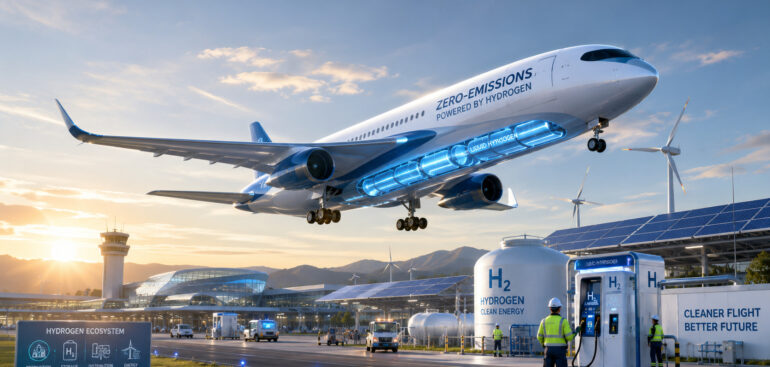
For that reason, on this occasion we will focus on the recently announced hydrogen airplane that is under development by Airbus, with the idea of being launched in 2030.

This is the industry’s response to other alternatives that are not so viable at this moment of technological development, such as electric and solar airplanes and airplanes that use liquefied natural gas. Regarding the first ones, the problem is found precisely in the batteries and does not have to do with storage capacity, but rather with the amount of power they can release.

A conventional passenger airplane, for example the Boeing 737, would require a battery that could store and release more energy per unit of mass than what is available at this moment, without considering that the cost is too high to be competitive.

On the other hand, natural gas would seem to be an option that combines low prices, considering that the shale gas revolution in the United States has produced the cheapest natural gas in the world with high availability and lower greenhouse gas emissions compared with jet fuel.

The problem with natural gas as a replacement fuel is that it has lower calorific power than kerosene; in order to be used, it would have to be liquefied natural gas, which requires investments and modifications to the existing infrastructure; furthermore, since its density will be lower, it would require doubling the weight of the fuel to maintain the same travel distance. In sum, development in that area has remained for small airplanes and local trips.

Considering this, the countries that are lined up in the development of the technologies that will define the future of energy see in hydrogen a possibility to transition toward airplanes with almost zero emissions and that could even be silent machines.

The concept is under development by Airbus and it is expected that it may be achieved by 2030, but the technology also has its challenges. The main one is discovering how to store liquid hydrogen during flight at very low temperatures and avoid the risks of the volatile fuel. However, in case of success, it would open a world of possibilities that could revolutionize the air transport industry and decrease the use of fossil sources.

As we pointed out some months ago, this may represent one of the most important applications within the hydrogen fever that motivates the most advanced research centers to take advantage of the opportunities to develop alternatives to continue with the advance of the energy transition even in the most difficult sectors such as aviation.

Ten years seem like a lot, but in scientific development and technological innovation it is a relatively short time that can charge us the bill as a country. With this panorama in mind, a public policy to promote science and technology for the energy sector was never more necessary. That would be a firm step toward true energy sovereignty sustained in the future and not in the old glories of the past.


This article was originally published by Business Insider México.
Date: October 7, 2020
Original Link: https://businessinsider.mx/avion-cero-emisiones-opinion-paul-sanchez-energia-circular/ [offline]
Archived Link: https://web.archive.org/web/20210515142831/https://businessinsider.mx/avion-cero-emisiones-opinion-paul-sanchez-energia-circular/ [Archived]