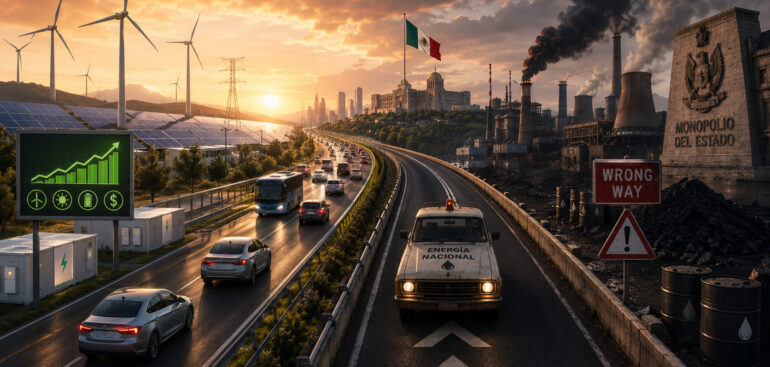

The Third Energy Revolution

"The nation that leads in renewable energy will be the nation that leads the world."
— James Cameron

We can define an energy revolution as a phenomenon in which a series of technological, economic, and social changes enable an exponential increase in the amount of energy available to societies and radically transform their social, economic, and political structures. In world history, there are two major events that fit this description.

The first is known as the Neolithic Revolution, which began with the development of agriculture and animal husbandry during the post-glacial period, around 10,000 BC. This transformation enabled the emergence of the first sedentary societies because increased food production allowed for a greater division of labor and reduced the amount of time, energy, and human effort devoted to hunting and gathering.

The Neolithic Revolution fundamentally transformed human history and laid the foundations for the economic system that would persist until the Industrial Revolution. Societies that mastered agriculture were able to devote more resources to military endeavors, leading to the rise of the first empires and to systems of slavery and serfdom as models of production based on working the land to generate more food, or, put differently, more energy for society.

The second revolution began with the Industrial Revolution in the mid-eighteenth century and was driven by the widespread adoption of the steam engine and the use of fossil fuels such as coal and oil. In just a few centuries, the amount of energy available to societies increased exponentially, replacing manual labor in textile production and reducing reliance on animals for work and transportation.

However, the industrial model that persists today remains fundamentally dependent on fossil energy sources. While this model has undoubtedly been closely associated with global economic development and rising standards of living, it has also generated significant social and environmental impacts and contributed to global warming.

In recent years, technological, social, and digital innovations have begun to outline what may become the leading drivers of a third energy revolution. On the one hand, technological innovation is characterized by increasing per capita electricity demand resulting from the growing number and personalization of technological devices, including smartphones, laptops, tablets, electric scooters, and electric vehicles.

On the other hand, social innovation is reflected in growing public demand for governments to adopt policies that encourage the deployment of renewable energy and promote an energy transition away from fossil fuels.

Alongside these developments, digital innovation is being driven by increasing connectivity and digitalization between centers of production and consumption. This has given rise to new activities such as data mining, social media platforms, and artificial intelligence, all of which depend heavily on electricity as their primary input.

Taken together, rising per capita electricity demand, the energy transition, and growing electricity consumption within an increasingly digital environment are beginning to establish the foundations of a third energy revolution based on renewable energy sources and electrical storage technologies. These developments will undoubtedly increase the amount of energy available to society and transform technological, economic, and social structures throughout the world.


This article was originally published by Business Insider México.
Date: July 1, 2020
Original Link: https://businessinsider.mx/tercera-revolucion-energetica-paul-alejandro-sanchez-opinion-energia-circular/ [offline]
Archived Link: https://web.archive.org/web/20210128141447/https://businessinsider.mx/tercera-revolucion-energetica-paul-alejandro-sanchez-opinion-energia-circular/ [Archived]

Cryptocurrencies and Energy


In the last two decades we have lived through an accelerated process of digitalization that has radically transformed traditional industries that are intimately linked to physical goods. People have stopped having albums filled with printed photographs to be replaced by thousands of digital photographs stored in the cloud or saved on a social network. We can say the same about tapes, compact discs, books, magazines and media outlets.

Perhaps there are hundreds of cases that can exemplify how some of the most traditional material expressions of past eras have been transformed into chains of digital information that are interpreted by computers, tablets and smartphones, but and, although money has not yet been digitalized, there are fiduciary currencies, which are completely digital and do not have the backing of the state, called cryptocurrencies.

The best known is Bitcoin, but there are hundreds of cryptocurrencies with their own characteristics. These digital currencies carry out virtual mining processes that require large amounts of processing power and, therefore, generate a great demand for energy. It is expected that by 2020, the annual income of the industry will be $3,000 million dollars, while the associated expenses will be 2,994 million dollars. This means that more than 99% of income is used to cover costs, and more than 80% of the cost is the payment of electricity.

Consequently, cryptocurrency mining is an extremely energy-intensive activity in such a way that it has become a source of global concern regarding greenhouse gas emissions and the imbalances they generate in deregulated energy markets where the marginal costs generated by this mining can generate a sensitive loss of welfare for the rest of consumers or require the dispatch of more expensive and polluting sources of energy to cover demand.

According to data from Digiconomist, it is estimated that the electric consumption from Bitcoin mining in 2019 was 64 TWh, this is equivalent to one fifth of Mexico’s electric generation in the same year. To compare, the electric consumption of Bitcoin mining in the world was practically the same as the consumption of all electric cars that circulated in 2019 on the planet.

Due to the above, it is estimated that the emissions of equivalent Carbon Dioxide that were released into the atmosphere due to Bitcoin mining were 28.44 million tons and 9,740 tons of electronic waste were produced in the process, and this without considering other cryptocurrencies such as Ethereum, which in 2019 consumed almost 8 TWh, almost double the electricity consumed by all electric vehicles in the United States in the same year.

Nevertheless, the hope is that this problem is solved as more renewable sources and energy storage systems are integrated to sustain the intensive energy consumption in data mining and, at the same time, reduce the greenhouse gas emissions that today characterize the cryptocurrency industry internationally.

Although this could seem to be a phenomenon isolated to the cryptocurrency industry, perhaps in a not very distant future we could be witnesses to the digitalization of all national currencies, just as at the time paper money replaced commodity money, such as gold and silver coins, this could be replaced by digitally interconnected chains of data which, without a doubt, will require a different energy model.


This article was originally published by Business Insider México.
Date: June 24, 2020
Original Link: https://businessinsider.mx/opinion-paul-sanchez-consumo-energiamineria-criptomonedas-dana-medio-ambiente/ [offline]
Archived Link: https://web.archive.org/web/20200805215859/https://businessinsider.mx/opinion-paul-sanchez-consumo-energiamineria-criptomonedas-dana-medio-ambiente/ [Archived]

The Hydrogen Rush

"Oh, Susanna, don't you cry for me,
I'm bound for the Lone Prairie with my pocket full of gold."
— Merrie Melodies (1942)

Have you ever wondered what the name of the San Francisco 49ers means? In 1848, a gold rush began in Northern California. Fortune seekers from the eastern and central United States started migrating to the state in search of instant wealth with relatively modest capital. Migration peaked in 1849, and those fortune seekers who arrived between 1848 and 1855 became known as the “forty-niners,” or simply the “49ers.”

A similar phenomenon occurred during the oil rush, the pursuit of “black gold,” in Pennsylvania between 1859 and 1880. Just as wild as the gold rush, the oil rush attracted countless fortune seekers, though only a few ultimately became truly wealthy. It was a gamble, but one with a relatively low cost of entry if fortune happened to smile upon you.

As a result, oil became the world’s primary energy source throughout much of the twentieth century. It powers national and international transportation systems, but it is also used to generate electricity and heat. However, recent efforts point toward a gradual reduction in oil use over the medium term and a transition toward hydrogen. This raises an important question: are we living through the hydrogen rush?

Transitions toward new forms of fuel are nothing new in the history of energy. In lighting, we moved from whale oil to kerosene and eventually to the electric light bulb. In electricity generation, we transitioned from small hydroelectric facilities to large coal-fired power plants, then to natural gas plants, and more recently to the rapid growth of renewable energy. In transportation, we progressed from animal-powered mobility to steam locomotives and eventually to petroleum-derived fuels such as gasoline, diesel, and fuel oil.

Hydrogen has become what nuclear energy once represented: a world of possibilities capable of transforming and unifying energy production and consumption over the long term. It offers potential not only for the generation of electricity and heat through hydrogen-powered plants, whose only byproduct is water, but also for energy storage and as a principal substitute fuel for passenger vehicles, freight transportation, light and heavy rail systems, and a variety of other high-value industrial applications.

Research centers in developed countries, a modern version of fortune seekers, are investing heavily in hydrogen-based technologies to solve many of the challenges associated with the energy transition. Just as the early gold and oil prospectors tested their luck and some ultimately generated wealth and regional development, the same may occur with the countries that are taking the first steps in the hydrogen rush.

Mexico possesses significant potential to develop an industry based on hydrogen applications. The challenge is simply to look toward the future rather than cling to the past and its former glories. Otherwise, we may find ourselves purchasing technologies developed elsewhere, much like the fortune seekers who arrived too late to the gold rush and ended up enriching the merchants selling shovels and pickaxes.


This article was originally published by Business Insider México.
Date: June 17, 2020
Original Link: https://businessinsider.mx/la-fiebre-del-hidrogeno-energia-circular-paul-alejandro-sanchez-opinion/ [offline]
Archived Link: https://web.archive.org/web/20240725122203/https://businessinsider.mx/la-fiebre-del-hidrogeno-energia-circular-paul-alejandro-sanchez-opinion/ [Archived]