In a very reductionist way, the origin of States implies a social contract where citizens choose to form a government that maintains order and fulfills other obligations for their benefit. To achieve this, human and material resources are required that must be covered with economic resources. Said in another way, governments need money to fulfill their tasks.
Governments have very limited ways of obtaining money. The most important and central one is taxes. That is, the imposition of participatory quotas on citizens, whether as individuals or as corporations, to maintain the actions of the government. The greater the tax burden, the more activities the government can develop optimally. However, it is a widely accepted consensus that citizens do not like paying taxes.
Another way in which governments can obtain income is through public debt, which is nothing other than obtaining money in advance that, in the end, will have to be paid with the government’s own income in the future. Debt is also very unpopular and dangerous because resources are committed in the long term to maintain payment to creditors.
In Mexico, however, an important part of public spending depends on two sources: oil revenues from the product of the sale of crude oil and taxes on fuels. As part of flexibility strategies, the Mexican government established a strategy based on establishing incentives when the price of gasoline was high, which were absorbed, in some way, by oil exports.
In recent years, the price of oil had remained relatively low —below 50 dollars per barrel— so, to maintain public revenues when the price of crude oil was low, the incentive to gasoline was reduced. This helped maintain the income not obtained from the sale of crude oil.
Consider that the use of oil causes serious problems related to climate change. Therefore, one of the logics of taxing fossil fuels is to dissuade their use in the long term to avoid their negative externalities or else to develop policies that allow correcting the consequences; for example, to adapt societies to climate change.
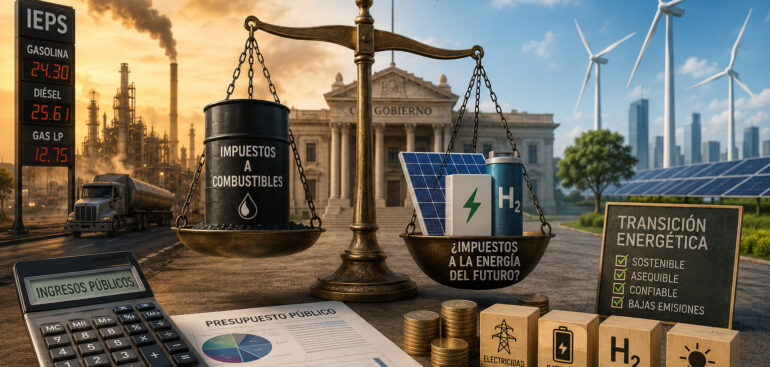
However, if one of the trends in the future is decarbonization, that would mean that taxes on fuels could disappear; with this, government revenues would decrease. Then, if fossil fuels are replaced by renewable sources of energy, how could said income be recovered?
Some proposals that have been debated in some countries regarding this topic are to tax, for example, electricity, batteries or even hydrogen. The logic behind these new levies would not be externalities, but collection itself.
Then, it would be possible that in the future, we see an IEPS on electricity, which by the way, this possibility has been established in the Constitution for some years. Perhaps, then, we could see taxes on the sun as in Spain some years ago or perhaps taxes on hydrogen as were recently approved in Argentina.
The challenge is that these taxes be progressive and that they do not condition the energy transition; at the same time that they allow governments to obtain the necessary resources for their continuous operation in the long term. For the moment, let this text serve to encourage the debate regarding the tax on energy in the future.
This article was originally published by Business Insider México.
Date: January 19, 2021
Original Link: https://businessinsider.mx/impuesto-energia-mexico-futuro-opinion-paul-sanchez-energia-circular/ [offline]
Archived Link: https://web.archive.org/web/20240222173025/https://businessinsider.mx/impuesto-energia-mexico-futuro-opinion-paul-sanchez-energia-circular/ [Archived]