
Energy in the Exploration of Mars


On February 18, the Perseverance rover arrived on Mars, after seven months of space navigation, and landed in the Jezero crater. This NASA tool promises to increase collect information regarding the environment of the red planet to determine the possibilities that there had been life in the past; if it can generate oxygen or if there are traces of water.

I must say it, Perseverance is an impressive piece of technology: it has 19 cameras, microphones and a drone in the form of a helicopter called Ingenuity. It weighs 1,025 kilograms and measures 2.2 meters high and 2.9 meters wide. In addition, for our analysis, it consumes 110 Watts of energy.

This is 50% more than what a laptop consumes or seven times less than what a microwave oven consumes. Surprisingly, the Ingenuity consumes more energy —350 Watts— according to NASA information.

How is Perseverance charged for exploration on Mars?

Considering that there are not many sources of energy on Mars, nor the means of development, Perseverance and Ingenuity must be very efficient and self-sustaining during their exploration mission. For the rover, the source of energy is a multi-mission radioisotope thermoelectric generator. Or, said in a very —but very— simple way, a nuclear battery.

The thermocouples of the battery convert the heat emitted by radioactive decay of a nuclear source; in this case a radioisotope of plutonium-238, into electrical energy. The generator charges two lithium-ion batteries and provides energy to Perseverance.

And, since 88 years are required for the radioisotope to reach its half-life —the unit of measurement to determine the time in which unstable atoms will survive radioactive decay—, we have a potential energy source for the rover for a while.

Why was this type of energy chosen for Perseverance?

This source was chosen over solar panels because of the operational flexibility that it would provide to the rover to operate in conditions of low solar irradiation during exploration on Mars. This assumption occurs at night, in winter or in adverse weather situations, such as sandstorms.

For its part, Ingenuity does use solar panels to charge its six lithium-ion batteries.

This experimental drone/helicopter weighs 1.8 kilograms and has only one mission: to explore the environment so that Perseverance can plan the best routes on its journey. To keep it light, it does not have any type of instrument beyond its camera and its solar panel.

NASA’s spending for the development of Perseverance was 2,500 million dollars and it will have an operation and maintenance cost of 150 million dollars per year. If we talk about its useful life being eleven years, the total amount will hover around 80,000 million pesos of 2020. Something like the entire subsidy of CFE last year.

The development and operation of the Rover Perseverance is one of the projects that will help us better understand our solar system; at the same time it puts into practice technological development in modern energy matters through the nuclear battery and the solar panels of Ingenuity. These developments are, without a doubt, important pieces to advance on the frontier of possibilities of energy use both on Earth and in space.


This article was originally published by Business Insider México.
Date: February 23, 2021
Original Link: https://businessinsider.mx/energia-exploracion-marte-como-carga-perseverance-paul-sanchez-opinio/ [offline]
Archived Link: https://web.archive.org/web/20240529213514/https://businessinsider.mx/energia-exploracion-marte-como-carga-perseverance-paul-sanchez-opinio/ [Archived]
Opposite Direction


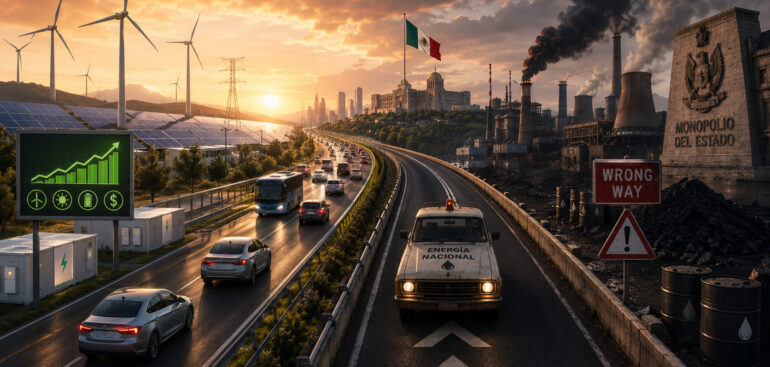
If on a highway all cars are coming in the opposite direction, we probably have to reflect on whether our car is not the one going backwards. In our national energy sector, it is evident that we need to stop and reflect on why we are going in a different direction from the rest of the world.

But first, it is true that we interrupt our usual programming, and I do not forget that we still have pending to talk about dark energy in the universe, the continuation of our previous installment, to talk about more banal topics but that are of great interest to all Mexicans in our day to day: the future of the national electric industry that is about to be defined, at least for the next four years.

This first of February, holiday due to the advance of the 104th anniversary of the Day of the Promulgation of the Political Constitution of the United Mexican States of 1917, the news woke us early, as has been customary, that on Friday the 29th the President of the Republic signed and delivered to the Congress of the Union a preferential initiative to modify the Electric Industry Law.

This is the most recent of a series of attempts that the federal government has made to return the electric sector to a state not only prior to the energy reform, but further back, to 1960 when then-president José Adolfo Mateos nationalized the entire electric industry to turn it into a monopoly operated by a state company, the Federal Electricity Commission (CFE).

In fact, in December 2019, CFE presented a list of demands that outlined this plan and that began with modest actions and omissions, particularly by the Energy Regulatory Commission (CRE) and the National Energy Control Center (Cenace), so that CFE would have a “level playing field,” a euphemism with which it is intended to return to the monopoly. Needless to say, currently, the state company controls more than 80% of the country’s electric generation, more than 80% of consumers; enjoys the monopoly of transmission and distribution, has one of the most important gas pipeline networks in Mexico and receives direct capital injections from the Mexican government.

In times of poor economic performance —in part because of the COVID-19 effect on our lives and because of a series of economic decisions of the current federal administration—, where countries seek to stimulate businesses and companies through support for spending on electric energy; where economic recovery is sought, attracting investment and generating jobs, and where it is sought to paint it as a green recovery, the actions derived from this preferential initiative place us in the opposite direction of the world.

The probability that this course of action will lead us to an imminent collision with other automobiles (countries) or that we come out with permanent damage (loss of competitiveness and country credibility) is high. On the one hand, the statement of reasons clearly dictates, without euphemisms, that the reform to the Electric Industry Law is carried out to strengthen CFE. This goes against the principle of free competition and free concurrence protected in constitutional article 28. Since 2013, generation and commercialization were removed as exclusive monopolies of the State in the Magna Carta to be considered economic activities under the regime of free competition.

Faced with a practice that violates the principles of economic competition that strengthen a State company, we could not rule out that American and Canadian companies are planning to take this issue to a controversy within the T-MEC. With a new government in the United States that actively promotes global decarbonization and the energy transition, then a crash is imminent caused by a vehicle, Mexico, that goes in the opposite direction, thinking that all the others are going in the opposite direction.

The problem is that not only has the driver not realized it, but he thinks that everyone else is the one going backwards. We return to our usual programming next week.


This article was originally published by Business Insider México.
Date: February 3, 2021
Original Link: https://businessinsider.mx/sentido-contrario-cfe-reforma-ley-industria-electica-paul-alejandro-sanchez/ [offline]
Archived Link: https://web.archive.org/web/20221205005654/https://businessinsider.mx/sentido-contrario-cfe-reforma-ley-industria-electica-paul-alejandro-sanchez/ [Archived]

The Tax on Energy in the Future


In a very reductionist way, the origin of States implies a social contract where citizens choose to form a government that maintains order and fulfills other obligations for their benefit. To achieve this, human and material resources are required that must be covered with economic resources. Said in another way, governments need money to fulfill their tasks.

Governments have very limited ways of obtaining money. The most important and central one is taxes. That is, the imposition of participatory quotas on citizens, whether as individuals or as corporations, to maintain the actions of the government. The greater the tax burden, the more activities the government can develop optimally. However, it is a widely accepted consensus that citizens do not like paying taxes.

Another way in which governments can obtain income is through public debt, which is nothing other than obtaining money in advance that, in the end, will have to be paid with the government’s own income in the future. Debt is also very unpopular and dangerous because resources are committed in the long term to maintain payment to creditors.

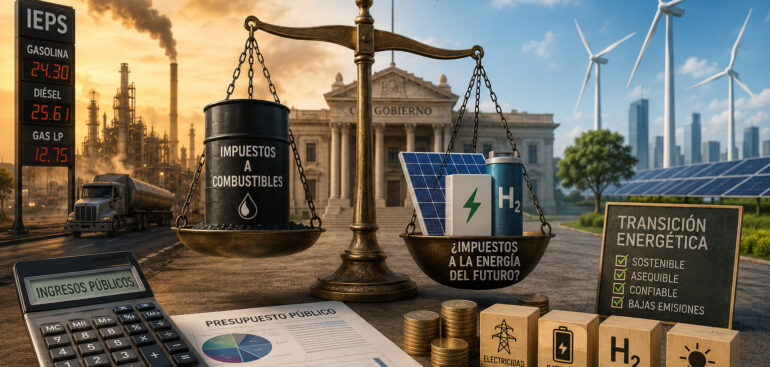
In Mexico, however, an important part of public spending depends on two sources: oil revenues from the product of the sale of crude oil and taxes on fuels. As part of flexibility strategies, the Mexican government established a strategy based on establishing incentives when the price of gasoline was high, which were absorbed, in some way, by oil exports.

In recent years, the price of oil had remained relatively low —below 50 dollars per barrel— so, to maintain public revenues when the price of crude oil was low, the incentive to gasoline was reduced. This helped maintain the income not obtained from the sale of crude oil.

Consider that the use of oil causes serious problems related to climate change. Therefore, one of the logics of taxing fossil fuels is to dissuade their use in the long term to avoid their negative externalities or else to develop policies that allow correcting the consequences; for example, to adapt societies to climate change.

However, if one of the trends in the future is decarbonization, that would mean that taxes on fuels could disappear; with this, government revenues would decrease. Then, if fossil fuels are replaced by renewable sources of energy, how could said income be recovered?

Some proposals that have been debated in some countries regarding this topic are to tax, for example, electricity, batteries or even hydrogen. The logic behind these new levies would not be externalities, but collection itself.

Then, it would be possible that in the future, we see an IEPS on electricity, which by the way, this possibility has been established in the Constitution for some years. Perhaps, then, we could see taxes on the sun as in Spain some years ago or perhaps taxes on hydrogen as were recently approved in Argentina.

The challenge is that these taxes be progressive and that they do not condition the energy transition; at the same time that they allow governments to obtain the necessary resources for their continuous operation in the long term. For the moment, let this text serve to encourage the debate regarding the tax on energy in the future.


This article was originally published by Business Insider México.
Date: January 19, 2021
Original Link: https://businessinsider.mx/impuesto-energia-mexico-futuro-opinion-paul-sanchez-energia-circular/ [offline]
Archived Link: https://web.archive.org/web/20240222173025/https://businessinsider.mx/impuesto-energia-mexico-futuro-opinion-paul-sanchez-energia-circular/ [Archived]