
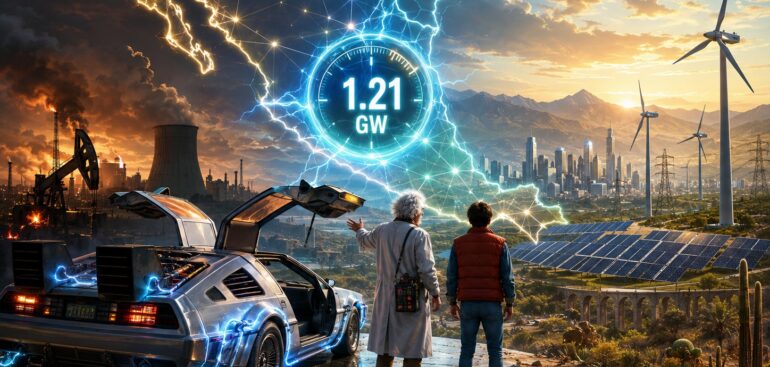
“1.21 Gigawatts!
How am I going to be able to generate so much energy? It is impossible”
-Dr. Emmett Brown
Many of you will remember that classic film from 1985: “Back to the Future.” In the movie, Marty McFly convinces Dr. Brown (“The Doc”) that he traveled to the past thanks to a time machine that he built in the future, and that it ran out of battery. Finally, the Doc agrees to help Marty, but he faces a great problem: producing 1.21 Gigawatts (GW) to turn on the DeLorean.
In the mid-1980s, nuclear energy seemed very promising; it was considered the future and the only way to put an end to fossil sources. Many things changed with the Chernobyl accident the following year, but that is another story.
Returning (to the future): it is 2020, they still do not sell plutonium in pharmacies and many things have changed in 35 years. The energy future is no longer deposited in nuclear energy, but in new-generation renewables — particularly solar and wind —, together with storage and hydrogen. That could be the winning combination of the future.
New-generation renewable energies have become the reference point of our present. Their spread is no longer part of a distant future difficult to see on the horizon, nor are their costs restrictive as before. Now they appear the same in homes as in businesses and industries, we can even see how large portions of agricultural lands are beginning to use their spaces to capture the sun.
If the Doc from “Back to the Future” had to generate 1.21 GW to turn on the DeLorean with current technology, could renewable energies in Mexico help him? Let us see.
According to figures from the Secretariat of Energy for the close of 2019, the installed capacity of electric energy in Mexico was 79.60 GW. This includes plants that use fossil sources, such as combined cycle plants that use natural gas, conventional thermal plants and internal combustion plants — which require diesel and fuel oil —; and coal-fired plants that, as their name indicates, use coal.
There is also hydroelectric energy, which uses dams and other bodies of water, and the nuclear energy that CFE operates in Laguna Verde, Veracruz. And, of course, we have solar photovoltaic, wind and geothermal energies.
The installed capacity of photovoltaic solar energy in Mexico represented 4.37% of the total in 2019, that is, a capacity of 3.4 GW. This means that if we used all the solar installations in the country at the same time for a couple of minutes, we could send Marty to the future almost three times. If we add wind energy, we can return him to the future eight times.
So great is Mexico’s renewable potential that on April 19 at noon, solar, wind, hydroelectric and geothermal energies together contributed 33% of the energy that was consumed at that moment. Solar energy alone contributed on average 1.76 Gigawatts every hour of the month, and I am sure that it is only the beginning.
In these times where renewable energies have become a topic of public debate, it is important to return to the future and leave the past behind. We can all design strategies that allow the country to achieve a true energy transition, integrate more renewable energies, reinforce electric networks, decentralize and digitalize consumption.
So, Doc, in the future they do not sell plutonium in pharmacies, but solar panels are very cheap and easy to get.
This article was originally published by Business Insider México.
Date: May 27, 2020
Original Link: https://businessinsider.mx/volver-al-futuro-energias-renovables-mexico-opinion-paul-alejandro-sanchez-energia-circular/