
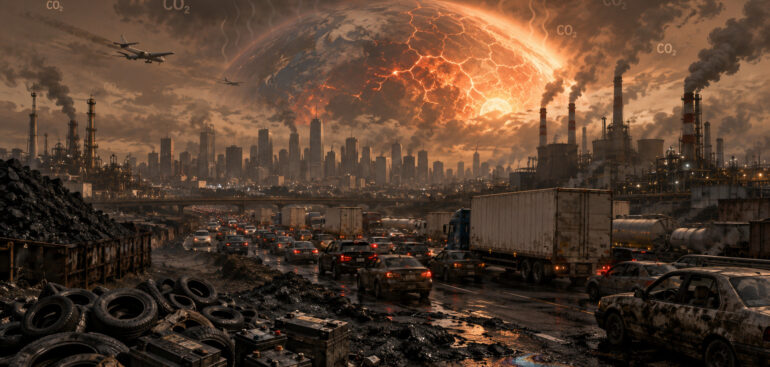
The Waste of the Present


“Our use of fossil sources pushes us to a point of no return.”

– Barack Obama

The massification of the automobile allowed an energy transition, particularly of the energy used for mobility. This allowed solving complicated public problems that the great cities of that time, such as New York and London, faced because of the waste of horses, the main means of transportation of that time, in the form of manure, urine and corpses.

However, despite the problems it solved, the adoption of new forms of energy and technologies brought with them their own problems. Although the waste of today, related to fossil sources, is multivariate and presents its own challenges, for example, used tires, batteries, coal mining or the used automobiles themselves, its most characteristic byproduct is greenhouse gas emissions.

The massification of the automobile and the development of electric plants based on fossil sources such as mineral coal and petroleum derivatives generated an increase in the emission of greenhouse gases, which made evident a series of social and environmental problems.

Global warming began to gain relevance in the world starting in the 1990s, particularly with the Earth Summit in Rio de Janeiro, Brazil, in 1992. The topic addressed particularly was the link between greenhouse gas emissions with the use of fossil sources of energy, with global warming, and the latter with climate change.

By the 1900s, the increase in the temperature of the Earth had been 0.2 degrees Celsius; with the massification of automobiles in the 1950s, an increase of 0.5 degrees Celsius was reached compared with the average temperature of the second half of the nineteenth century. By the year 2000, it had already reached 0.7 degrees and in 2018–2019 an increase of 1.2 degrees Celsius.

Undoubtedly, the economic, scientific, technological and social development of the world is intimately linked to a greater availability of energy, which opened a world of possibilities to expand the frontier of expansion of the global economy at an important cost: climate change.

It would not be fair to say that there were alternatives because, as I indicated in last week’s article, in the past there were also environmental impacts that were unsustainable in the long term. However, it is important to note that it is this public problem of global character that is the main reason why the international community has pressed for an accelerated energy transition based on the decrease in the intensity of the use of fossil sources of energy and greater use of renewable energy sources and storage.

Many solid advances have been made along that path; solar and wind have now contributed 10% of the energy consumed in the world, while generation based on mineral coal has lost almost the same amount, 8% in the same period, in such a way that it is not impossible to think that in a not very distant future we could see its replacement as a primary source of energy.

However, renewable and green sources, storage, electric automobiles, hydrogen and other technologies that are defining the future of energy, do they not generate waste, refuse or residues of some kind? The answer is yes, and just as in the past the horse generated an impact on the environment and today fossil sources do as well, it is a fact that in the future, energy waste will also change and we will talk about that next week. Until then.


This article was originally published by Business Insider México.
Date: August 19, 2020
Original Link: https://businessinsider.mx/basura-del-presente-energia-circular-opinion-paul-alejandro-sanchez/ [offline]
Archived Link: https://web.archive.org/web/20210306233903/https://businessinsider.mx/basura-del-presente-energia-circular-opinion-paul-alejandro-sanchez/ [Archived]

The Waste of the Past


“If I had asked people what they wanted, they would have told me faster horses”

– Henry Ford

The waste and refuse of an era are associated with the dominant technology. That is, the waste of the past is not the same as the waste of the present and, rest assured, the waste of the future will have new characteristics that today are not analyzed in great depth. With this in mind, this week we open a series of three installments to analyze the waste, refuse and residues related to energy in the past, present and future.

To speak of the past, we will not go back to the ice age, but to the zenith of the energy model prior to the massification of internal combustion automobiles, between the end of the nineteenth century and the beginning of the twentieth century, when transportation powered by the muscle of animals dominated, particularly by horses.

The main source of energy of this means of transportation was, precisely, food and, of course, it required maintenance and particular spare parts, for example, the changing of horseshoes, medicine, water and an appropriate place for rest. As you can imagine, the main waste of that transportation system was the manure and urine of the horses that fell directly onto the streets and, of course, their corpses when they passed to a better life.

It is estimated that in New York more than 600 liters of urine and more than three tons of manure were poured per day. Additionally, each year more than 15,000 horse corpses were discarded per day, which represented a replacement rate of between 15% and 20% per year. In other words, demand was growing and so was the need to raise more horses.

This situation generated jobs and entrepreneurs did business. For example, the excess of urine required that the streets be washed several times a day and for this, carts were created that transported water with this function and government workers were in charge of washing the streets. For their part, organized manure collectors and depots appeared who charged for lifting and disposing of the waste. More than 20,000 horses and mules were used in New York for the tasks of collection and disposal of waste and street washing.

However, this mobility model also generated damage to health. It is estimated that in the 1900s, in New York, around 20,000 people died per year because of diseases related to horse waste that were transmitted through the air. Therefore, the collection and disposal of waste was fundamental.

Given the growth projections, most historians agree that the use of the horse was not sustainable in the long term for three reasons: the management of waste, the increase in the cost of horse food that was already becoming more expensive than coal and because of the methane emissions that would have been released into the atmosphere due to a world mobilized by horses.

On the other hand, coal was the primary energy source for thermoelectric generation, steam engines and mobilization by railroad and ships. Therefore, in addition to the environmental impacts in its extraction, greenhouse gas emissions were also generated. In such a way that the great industrial cities of the time were characterized by soot, black clouds and poor air quality.

Although today hydrocarbons have become the villains to defeat in order to mitigate climate change, their adoption in the first quarter of the twentieth century allowed a first energy transition that helped improve the management of manure and coal and more. We will analyze this next week. Until then.


This article was originally published by Business Insider México.
Date: August 12, 2020
Original Link: https://businessinsider.mx/basura-del-pasado-energia-circular-opinion-paul-alejandro-sanchez/ [offline]
Archived Link: No server is available to handle this request. [Archived]

Democratization: The Fourth D of the Energy Future


There can be no democracy without citizenship every day

– Ralph Nader

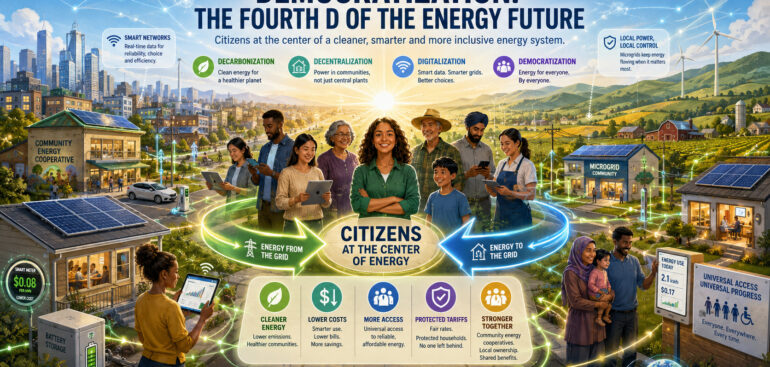
In recent weeks I have addressed three trends of the energy future: decarbonization, decentralization and digitalization. Together these three trends create and reinforce a fourth trend: the democratization of energy, which is the fourth D of the energy future.

Democratization, for the purposes of this article, is not related to the concept of political science that refers to the transition from authoritarian political regimes to democratic ones, but it does take the most important component of the concept of democracy: the citizen who is the center of the democratic process.

A related concept would be the democratization of knowledge, which refers to the process of disseminating knowledge among ordinary people, thereby breaking the concentrations of knowledge enjoyed by elites. Libraries and access to the internet are sources that allow knowledge to be democratized.

In the same way, democratizing energy implies the process of breaking the barriers that prevent universal access to energy and the adaptation of consumption centers into production centers. This implies several things, but the most important is to develop regulation that places the consumer, the user and the citizen at the center.

This means that they are freely allowed to choose their energy provider and their source of generation; that they are allowed to install solar panels on their roofs without the need for complex regulations that benefit horizontally and vertically integrated production chains; and above all it implies that all citizens have access to energy, understanding by this not only electrification but having the capacity to pay or having a protected tariff according to their basic needs.

Just as in political democracy the source of the legitimacy of the ruler is deposited by sovereign citizens as a whole, the energy sector starts from the same logic, from the existence of social demands that are important for the development of a modern energy future for new generations.

This includes decarbonization reflected in a responsible consumption of energy that must consider the least possible impact on the environment. It also includes the breaking of state monopolies and State control in matters of provision of energy services and redesigning its role as regulator and protector of citizens, that is, a process of decentralization.

It also includes taking advantage of the resources that digitalization places within reach of modern societies for the consolidation of a sector that takes advantage of the interconnectivity of consumption centers with production centers and breaks with the limitations of the integration of renewable energies into energy distribution and transmission networks, which must at all times be intelligent.

And, of course, it implies paying attention to the most unprotected, marginalized and vulnerable, to those citizens who do not have access to energy or who have access to energy of lower quality — such as firewood or other solid fuels — or who have access to polluting energy or who, having an electric connection, for example, cannot pay their electricity bills.

The gap in access to energy is the fundamental source of energy poverty and inequality and that has an impact on the quality of life of citizens. In an energy democracy that must matter. The democratization of energy is therefore about bringing more energy at lower prices at lower environmental and social costs and that goes hand in hand with the digitalization, decentralization and decarbonization of the energy sector of the future.


This article was originally published by Business Insider México.
Date: August 5, 2020
Original Link: https://businessinsider.mx/democratizacion-energia-electrica-futuro-energetico-energia-circular-opinion-paul-sanchez/ [offline]
Archived Link: https://web.archive.org/web/20210306234818/https://businessinsider.mx/democratizacion-energia-electrica-futuro-energetico-energia-circular-opinion-paul-sanchez/ [Archived]