
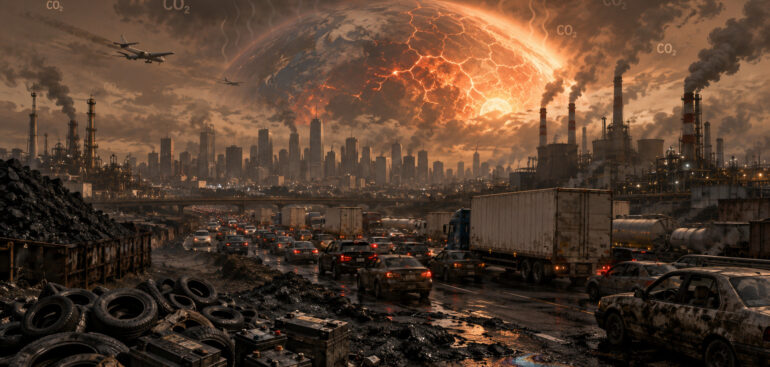
“Our use of fossil sources pushes us to a point of no return.”
– Barack Obama
The massification of the automobile allowed an energy transition, particularly of the energy used for mobility. This allowed solving complicated public problems that the great cities of that time, such as New York and London, faced because of the waste of horses, the main means of transportation of that time, in the form of manure, urine and corpses.
However, despite the problems it solved, the adoption of new forms of energy and technologies brought with them their own problems. Although the waste of today, related to fossil sources, is multivariate and presents its own challenges, for example, used tires, batteries, coal mining or the used automobiles themselves, its most characteristic byproduct is greenhouse gas emissions.
The massification of the automobile and the development of electric plants based on fossil sources such as mineral coal and petroleum derivatives generated an increase in the emission of greenhouse gases, which made evident a series of social and environmental problems.
Global warming began to gain relevance in the world starting in the 1990s, particularly with the Earth Summit in Rio de Janeiro, Brazil, in 1992. The topic addressed particularly was the link between greenhouse gas emissions with the use of fossil sources of energy, with global warming, and the latter with climate change.
By the 1900s, the increase in the temperature of the Earth had been 0.2 degrees Celsius; with the massification of automobiles in the 1950s, an increase of 0.5 degrees Celsius was reached compared with the average temperature of the second half of the nineteenth century. By the year 2000, it had already reached 0.7 degrees and in 2018–2019 an increase of 1.2 degrees Celsius.
Undoubtedly, the economic, scientific, technological and social development of the world is intimately linked to a greater availability of energy, which opened a world of possibilities to expand the frontier of expansion of the global economy at an important cost: climate change.
It would not be fair to say that there were alternatives because, as I indicated in last week’s article, in the past there were also environmental impacts that were unsustainable in the long term. However, it is important to note that it is this public problem of global character that is the main reason why the international community has pressed for an accelerated energy transition based on the decrease in the intensity of the use of fossil sources of energy and greater use of renewable energy sources and storage.
Many solid advances have been made along that path; solar and wind have now contributed 10% of the energy consumed in the world, while generation based on mineral coal has lost almost the same amount, 8% in the same period, in such a way that it is not impossible to think that in a not very distant future we could see its replacement as a primary source of energy.
However, renewable and green sources, storage, electric automobiles, hydrogen and other technologies that are defining the future of energy, do they not generate waste, refuse or residues of some kind? The answer is yes, and just as in the past the horse generated an impact on the environment and today fossil sources do as well, it is a fact that in the future, energy waste will also change and we will talk about that next week. Until then.
This article was originally published by Business Insider México.
Date: August 19, 2020
Original Link: https://businessinsider.mx/basura-del-presente-energia-circular-opinion-paul-alejandro-sanchez/ [offline]
Archived Link: https://web.archive.org/web/20210306233903/https://businessinsider.mx/basura-del-presente-energia-circular-opinion-paul-alejandro-sanchez/ [Archived]