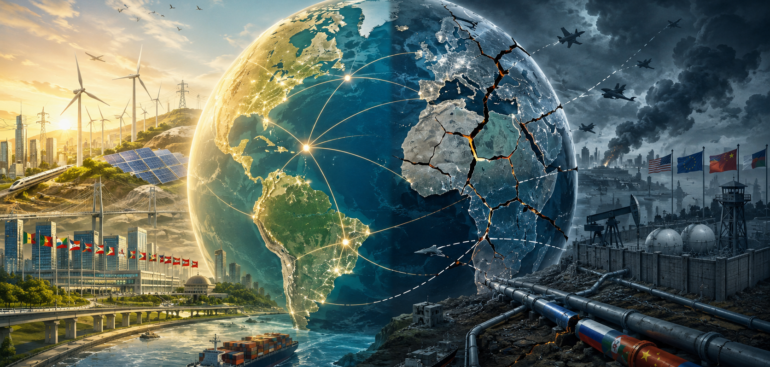
The energy transition planned and developed through international agreements is framed within the project of world order after the Cold War. This project, however, requires economic stability and global peace to foster international cooperation from an approach of mutual gains. Current events not only question the validity of the world order based on globalization, but also change the traditional paradigm of the energy transition that was gestated in this world order.
Let us go back in time three decades and return to the 1990s. In general, it could be said that this decade was marked by international optimism and economic stability, not to say an economic boom. The fall of the Berlin Wall, the disintegration of the Soviet Union and the end of the Cold War brought to an end the bipolar global order that governed the international community since the 1950s, which generated confidence to establish a new world order based on international free trade.
The appearance of regional blocs based on this new idea was a reflection of the possibility of a global world. The North American Free Trade Agreement created the largest commercial region in the world, while the Maastricht Treaty laid the foundations to advance in the integration of the European Union. The need to advance in the development of the less favored countries in Europe, Asia and Latin America was also recognized, leaving aside colonial aspirations of the countries but generating mechanisms for free trade.
“It was recognized, then, a threat to international security different from the traditional threats of the postwar period.”
With the threats of mutual global destruction due to a nuclear conflict behind, the international community began to concentrate on other social demands such as climate change. In the 1990s, the Earth Summit, the creation of the United Nations Framework Convention on Climate Change and the adoption of the Kyoto Protocol were pillars to guide the first global efforts of decarbonization. It was recognized, then, a threat to international security different from the traditional threats of the postwar period.
Facing the Russia and Ukraine conflict, the possibility of continuing under this model of multilateral cooperation in the future is questioned and it reveals the difficulty of maintaining cohesion to achieve common objectives, particularly in the energy and international decarbonization issue. It would seem that with this the stage of international optimism closes to return to that of multipolar political realism where each region defines its priorities based on its particular interests.
This article was originally published by Energía a Debate.
Date: Aplirl 5, 2022
Link: https://energiaadebate.com/la-energia-y-la-globalizacion/ [Online]