The energy transformation of our times advances, in a discreet way but at a good pace. There are several races that seek to break with the current limits of technologies; they can become the dominant standard of the global energy sector in the future.
Recently, GE launched the Haliade-X, a 13 MW mega wind turbine that makes the 2.5 MW turbines in La Venta, Oaxaca pale. We can see the same with technological companies that seek to integrate perovskite into solar panels to make them more efficient; batteries with greater duration, cheaper and more compact, among many other events. But a technological race to which we should pay special attention is that of artificial suns.
But what is an artificial sun?
In reality it is an apparatus that uses high-temperature plasma superconducting technology and high magnetic fields to approach atomic fusion, similar to what happens inside a sun. To achieve this, the fusion fuel must be heated to temperatures of more than 200 million degrees Kelvin, where matter becomes plasma.
Before fusion occurs, the electric repulsion of the atomic nucleus allows the atoms to come physically close enough to fuse. Fusion, then, promises the use of this reaction to provide virtually unlimited, safe energy with zero greenhouse gas emissions.
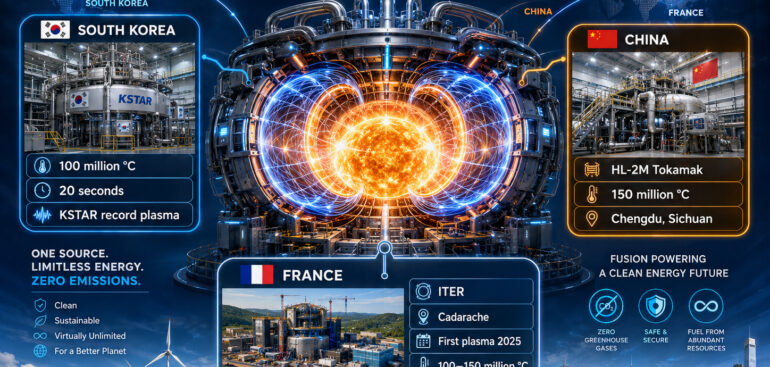
Some countries that are in this race for the development of their own artificial suns are South Korea and China. In South Korea it is developed at the Korean Center for Advanced Tokamak Superconductivity Research of the Korean Fusion Institute, with support from Seoul National University and Columbia University of the United States. On November 24, 2020, this project maintained the continuous operation of plasma with an ionic temperature of more than 100 million degrees Celsius for 20 seconds. These 20 seconds represent a record not reached by other projects.
For its part, the China National Nuclear Corporation developed the HL-2M Tokamak that operates at temperatures of 150 million degrees Celsius and is located in the city of Chengdu, within the province of Sichuan. However, this is only the largest and most stable of the artificial suns that are developed in the country.
Another country that also advances in this race is France through the International Thermonuclear Experimental Reactor that is being built in Cadarache within the European country. The development will have an estimated cost of 24,000 million euros and it is expected to obtain its first plasma by 2025. It is estimated that the temperature of this project could be between 100 and 150 million degrees Celsius.
Unlike atomic fission nuclear plants, which we addressed in the past, and which face difficulties to continue advancing and keep their costs low, the development of artificial suns that use nuclear fusion has a more promising future that could become an important piece in the competition to achieve clean, cheap and reliable energy.
This could be fundamental to achieve objective seven of the Sustainable Development Goals, which refers to achieving total coverage of electricity in the world through modern, affordable, renewable and reliable sources. A synergy that, in combination with solar, wind, hydrogen and storage developments, could be the energy pillars of a future without greenhouse gas emissions.
This article was originally published by Business Insider México.
Date: January 12, 2021
Original Link: https://businessinsider.mx/carrera-sol-artificial-paul-alejandro-sanchez-opinion-energia-circular/ [offline]
Archived Link: https://web.archive.org/web/20211027225428/https://businessinsider.mx/carrera-sol-artificial-paul-alejandro-sanchez-opinion-energia-circular/ [Archived]