
What NASA Can Teach CFE

"They were building a Ferrari for every launch when a Honda Accord could get the job done."
— Elon Musk

On May 30, the first private space mission was launched by Elon Musk’s company SpaceX, whose founder is also known for creating Tesla. The mission carried two NASA astronauts to the International Space Station. The launch represented the first crewed spaceflight departing from the United States in nearly a decade and what some have called the beginning of the private space race. Can this teach us any lessons for CFE?

It would be difficult to imagine an area more strategic for a government than its space program, particularly when that program is closely tied to an arms race and ideological competition under the perceived threats of the Cold War. As such, it received substantial public funding to sustain its operations.

However, in the more than sixty years since its creation, the world has changed dramatically in political, economic, and social terms. The welfare state model gradually became strained, largely because of the growing resources required to sustain government structures, and with it came a reduction in the amounts governments could devote to strategic sectors.

For example, NASA’s budget declined from USD 43.554 billion to USD 22.559 billion between 1966 and 2020 (in constant 2014 dollars). As a result, the agency was forced to retire some of its most emblematic programs, including the crewed Space Shuttle Program, which operated for thirty years from 1981 to 2011. In total, the program completed 135 missions, each with a launch cost ranging from USD 450 million to USD 1.5 billion.

The most important lesson from the launch of SpaceX’s Dragon spacecraft is that it cost approximately USD 50 million, only about 10 percent of the cost of the least expensive NASA Space Shuttle launch. As a result, NASA has decided to become one of the company’s principal customers for transporting astronauts into space.

In other words, NASA continues to carry out strategic activities in the space sector while concentrating its resources and efforts where they can generate the greatest value for the country and the world, such as the remote exploration of Mars, Jupiter, and Saturn, as well as deep-space exploration through its satellites. At the same time, it leaves launch services to private companies that can perform them more efficiently and at lower cost.

Viewed in this way, CFE could learn a great deal from NASA by focusing on the strategic areas that generate the highest value per unit of investment, such as transmission, distribution, telemetry, natural gas transportation, and natural gas marketing, among others. At the same time, it could move away from volumetric electricity generation targets that require the continued operation of expensive, inefficient, and highly polluting plants fueled by fuel oil and coal. Such generation could instead be replaced by low-cost clean and renewable energy, such as that procured through the Long-Term Electricity Auctions, benefiting both public health and consumers’ wallets.

Who knows? Instead of continuing to repair the legendary Volkswagen Beetle with a Ferrari-sized budget, perhaps CFE could accomplish far more for all Mexicans, just as NASA has done.


This article was originally published by Business Insider México.
Date: June 3, 2020
Original Link: https://businessinsider.mx/lo-que-la-nasa-puede-ensenarle-a-cfe-opinion-paul-alejandro-sanchez-energia-circular/ [offline]
Archived Link: https://web.archive.org/web/20210117004053/https://businessinsider.mx/lo-que-la-nasa-puede-ensenarle-a-cfe-opinion-paul-alejandro-sanchez-energia-circular/ [Archived]


Back to the Future

"1.21 Gigawatts!
How am I supposed to generate that much power? It's impossible!"
— Dr. Emmett Brown

Many of you will remember the 1985 film classic Back to the Future. In the movie, Marty McFly convinces Dr. Brown (“Doc”) that he traveled to the past using a time machine that Doc himself built in the future, and that it has run out of power. Eventually, Doc agrees to help Marty, but he faces a major challenge: generating 1.21 gigawatts (GW) to power the DeLorean.

In the mid-1980s, nuclear energy seemed extremely promising. It was considered the future and the only way to move beyond fossil fuels. Many things changed after the Chernobyl accident the following year, but that is another story.

Returning to the future: it is now 2020, pharmacies still do not sell plutonium, and many things have changed over the past 35 years. The future of energy is no longer centered on nuclear power, but rather on next-generation renewables, particularly solar and wind energy, combined with energy storage and hydrogen. That may well be the winning combination of the future.

Next-generation renewable energy technologies have become a defining feature of our present. Their expansion is no longer part of some distant future barely visible on the horizon, nor are their costs as prohibitive as they once were. Today, they can be found in homes, businesses, and industries alike. We can even see large portions of agricultural land beginning to use their available space to harvest sunlight.

If Doc from Back to the Future had to generate 1.21 GW to power the DeLorean using today’s technology, could renewable energy in Mexico help him? Let’s find out.

According to figures from Mexico’s Ministry of Energy, installed electricity generation capacity reached 79.60 GW by the end of 2019. This includes plants powered by fossil fuels, such as combined-cycle plants fueled by natural gas, conventional thermal plants, and internal combustion facilities that require diesel and fuel oil, as well as coal-fired power plants that, as their name suggests, use coal.

There is also hydroelectric power, which relies on dams and other water resources, and nuclear energy generated by the Federal Electricity Commission (CFE) at the Laguna Verde Nuclear Power Plant in Veracruz. And, of course, there are solar photovoltaic, wind, and geothermal energy sources.

Solar photovoltaic capacity represented 4.37 percent of Mexico’s total installed capacity in 2019, equivalent to 3.4 GW. This means that if all of the country’s solar installations operated simultaneously for a few minutes, we could send Marty into the future nearly three times. If we add wind power, we could send him back to the future eight times.

Mexico’s renewable energy potential is so significant that on April 19 at midday, solar, wind, hydroelectric, and geothermal energy sources together supplied 33 percent of the electricity being consumed at that moment. Solar power alone contributed an average of 1.76 gigawatts every hour throughout the month, and I am confident that this is only the beginning.

At a time when renewable energy has become the subject of public debate, it is important to return to the future and leave the past behind. We can all help design strategies that enable the country to achieve a genuine energy transition, integrate more renewable energy, strengthen electrical grids, decentralize energy systems, and digitize consumption.

So, Doc, in the future pharmacies do not sell plutonium, but solar panels are very inexpensive and easy to find.


This article was originally published by Business Insider México.
Date: Mayo 27, 2020
Original Link: https://businessinsider.mx/volver-al-futuro-energias-renovables-mexico-opinion-paul-alejandro-sanchez-energia-circular [offline]
Archived Link: https://web.archive.org/web/20240227201720/https://businessinsider.mx/volver-al-futuro-energias-renovables-mexico-opinion-paul-alejandro-sanchez-energia-circular/[Archived]

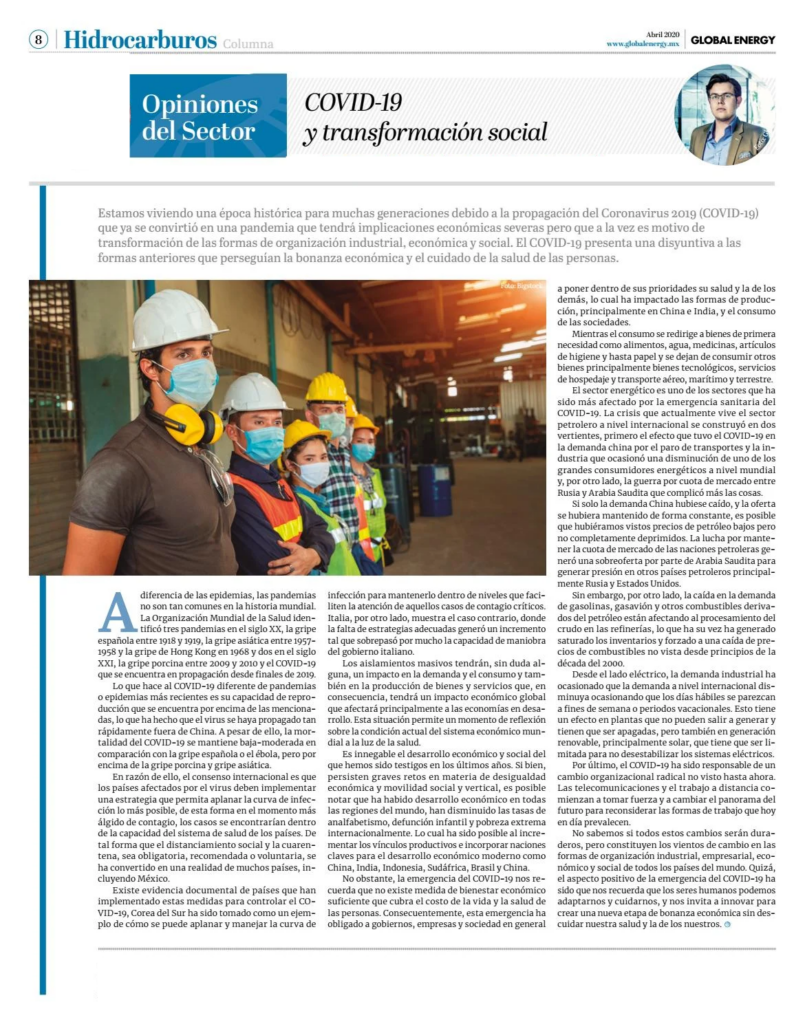
COVID-19 and Social Transformation

We are living through a historic moment for many generations due to the spread of Coronavirus Disease 2019 (COVID-19), which has already become a pandemic with severe economic implications while also serving as a catalyst for transforming industrial, economic, and social forms of organization. COVID-19 presents a challenge to previous models that sought to balance economic prosperity with the protection of human health.

Unlike epidemics, pandemics are not particularly common in world history. The World Health Organization identified three pandemics during the twentieth century: the Spanish flu between 1918 and 1919, the Asian flu between 1957 and 1958, and the Hong Kong flu in 1968; and two during the twenty-first century: the swine flu between 2009 and 2010 and COVID-19, which has been spreading since late 2019.

What makes COVID-19 different from more recent pandemics and epidemics is its reproductive capacity, which exceeds that of those previously mentioned. This has enabled the virus to spread rapidly beyond China. Despite this, COVID-19’s mortality rate remains low to moderate when compared to the Spanish flu or Ebola, though higher than that of swine flu and Asian flu.

For this reason, the international consensus has been that countries affected by the virus should implement strategies aimed at flattening the infection curve as much as possible. In this way, during the peak of contagion, the number of cases would remain within the capacity of national healthcare systems. As a result, social distancing and quarantine, whether mandatory, recommended, or voluntary, have become a reality in many countries, including Mexico.

There is documented evidence from countries that have implemented these measures to control COVID-19. South Korea has been regarded as an example of how the infection curve can be flattened and managed in order to maintain contagion levels that allow healthcare systems to adequately treat critical cases. Italy, on the other hand, illustrates the opposite scenario, where the absence of adequate strategies generated an increase in cases that far exceeded the Italian government’s capacity to respond.

Mass isolation measures will undoubtedly have an impact on demand and consumption, as well as on the production of goods and services, which in turn will have a global economic impact affecting developing economies most significantly. This situation provides an opportunity to reflect on the current condition of the global economic system in light of public health considerations.

The economic and social development witnessed in recent years is undeniable. Although significant challenges remain in terms of economic inequality and social mobility, it is possible to observe economic development across all regions of the world. Rates of illiteracy, infant mortality, and extreme poverty have declined internationally. This has been made possible through stronger productive linkages and the integration of key nations into the modern global economy, including China, India, Indonesia, South Africa, Brazil, and China.

Nevertheless, the emergence of COVID-19 reminds us that no measure of economic well-being can compensate for the value of human life and health. Consequently, this emergency has compelled governments, businesses, and society at large to prioritize both their own health and the health of others. This has affected production patterns, particularly in China and India, as well as consumption patterns around the world.

As consumption shifts toward essential goods such as food, water, medicines, hygiene products, and even toilet paper, other goods and services, particularly technology products, lodging services, and air, maritime, and land transportation, experience declining demand.

The energy sector is among the sectors most severely affected by the COVID-19 health emergency. The crisis currently facing the international oil industry developed along two fronts. First, COVID-19 affected Chinese demand due to transportation shutdowns and industrial slowdowns, reducing consumption from one of the world’s largest energy consumers. Second, the struggle for market share between Russia and Saudi Arabia further complicated the situation.

Had only Chinese demand declined while supply remained constant, oil prices would likely have fallen but not become completely depressed. The competition to preserve market share among oil-producing nations led Saudi Arabia to increase supply in order to exert pressure on other oil-producing countries, particularly Russia and the United States.

At the same time, declining demand for gasoline, jet fuel, and other petroleum products has affected refinery operations, resulting in inventory buildups and forcing a collapse in fuel prices not seen since the early 2000s.

From the electricity perspective, reduced industrial activity has caused international electricity demand to decline, making weekdays resemble weekends or holiday periods. This affects generating plants that can no longer operate and must be shut down, but it also impacts renewable generation, particularly solar power, which must sometimes be curtailed to avoid destabilizing electrical systems.

Finally, COVID-19 has been responsible for a radical organizational shift unlike anything seen before. Telecommunications and remote work have begun to gain momentum and reshape future expectations, prompting a reconsideration of prevailing workplace models.

We do not yet know whether all these changes will endure, but they represent winds of change in the industrial, business, economic, and social organization of countries around the world. Perhaps the positive aspect of the COVID-19 emergency is that it reminds us that human beings are capable of adapting and caring for one another, while encouraging us to innovate and create a new era of economic prosperity without neglecting our own health and the health of those around us.

This article was originally published by Global Energy, Volume 11, Issue 142, April 2020.
Date: April, 2020
Original: Printed Edition.
Archived Link: https://issuu.com/globalenergymx/docs/01-portada-ge142 [Archived]