
Energy Inquisition

Mexico is living its full Energy Middle Ages. Of course I am not referring to the fact that we are using candles and whale oil, but if this trend continues, little would be missing for that. Not only because we live in an obscurantism in which official data on energy is hidden or buried in formats difficult to access and where new ideas are rejected, or because a system of energy vassalage is being implemented where we are all vassals, peasants or slaves of CFE; but because, in addition —and hand in hand with these two concepts—, we are in an Energy Inquisition orchestrated from the pulpits of public power and the State company.

For months, the federal government, starting with the president and the Secretariat of Energy, even leaders of the governing party, has taken on the task of winning the battle of the narrative that the electric reform initiative presented by the Head of the Executive himself is good for the people. Every day messages are positioned on television, radio, social networks, press conferences and in all possible media in defense of the initiative.

Also, week after week, some CFE official comes out to defend, either in the media or through press releases, the presidential proposal. In many cases showing the lack of technical knowledge of the electric sector, of the operational and financial management of the company or of legal practice itself.

However, the greatest problem is the very personal task that the direction of CFE and its social communication area have imposed on themselves by launching replies to any criticism or opinion published by experts, analysts, journalists or almost any person in any media outlet.

“…poor is the one who dares to question because he will end up in the virtual bonfire of CFE…”

Like the Spanish Inquisition of the Middle Ages, the selective persecution carried out by CFE is brutal. Week after week they attack without solid arguments, without figures, without graphs and in a personal way anyone who dares to publish some critical thought regarding the areas of opportunity and negative aspects of the initiative. Public lynching does not take long, nor does the bonfire from power to burn the reputation of those who do not retract. The end, as I pointed out, is to win the narrative, whatever the cost.

The worst part, with all the machinery of the self-proclaimed most powerful company in Mexico, is that substantial arguments based on official figures or evidence are not presented, but rather disqualification and personal accusations are resorted to. Arguments sustained in ad hominem, ad baculum and ad populum fallacies wholesale.

If someone writes that the solution to solve climate problems, advance in the energy transition and optimize the country’s electric resources is not hydroelectric plants, CFE’s reply does not present data, but limits itself to branding the opinion as unfounded improvisation.

If someone shows them that the prices of electric energy from private plants are lower than those of CFE itself according to the data of the Energy Regulatory Commission itself, CFE limits itself to attacking the person and calling him a “lobbyist for private companies” and “enemy of the state company.”

Or if someone questions the hidden subsidies that CFE points out so much and of which it has not presented any proof based on the government’s official documents or statistics, they limit themselves to presenting some unsupported figure, pointed out again and again while waiting for it to become true, and accuse, without further proof or foundation, of promoting foreign interests.

The three examples are real and are a sample of a systemic phenomenon that occurs within the state electric company. It is, then, an energy inquisition that only seeks to give a reply without contributing to the discussion and debate, only to promote its particular interest and not that of society, so poor is the one who dares to question because he will end up in the virtual bonfire of CFE, since it now seems that the fundamental right to be protected is not free expression, but persecution.


This article was originally published by Energía a Debate.
Date: November 22, 2021
Link: https://energiaadebate.com/inquisicion-energetica/ [Online]
Democratization: The Fourth D of the Energy Future


There can be no democracy without citizenship every day

– Ralph Nader

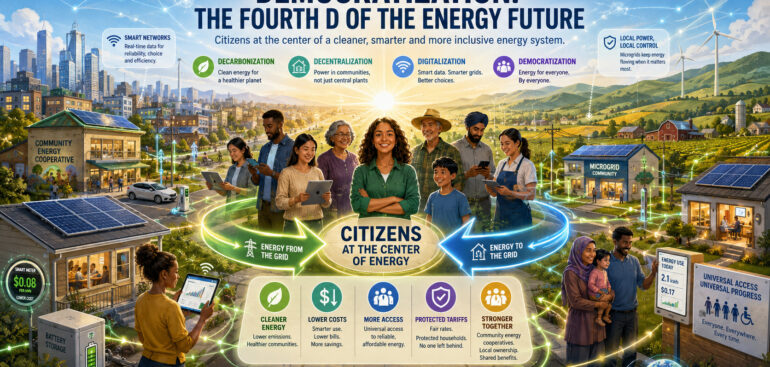
In recent weeks I have addressed three trends of the energy future: decarbonization, decentralization and digitalization. Together these three trends create and reinforce a fourth trend: the democratization of energy, which is the fourth D of the energy future.

Democratization, for the purposes of this article, is not related to the concept of political science that refers to the transition from authoritarian political regimes to democratic ones, but it does take the most important component of the concept of democracy: the citizen who is the center of the democratic process.

A related concept would be the democratization of knowledge, which refers to the process of disseminating knowledge among ordinary people, thereby breaking the concentrations of knowledge enjoyed by elites. Libraries and access to the internet are sources that allow knowledge to be democratized.

In the same way, democratizing energy implies the process of breaking the barriers that prevent universal access to energy and the adaptation of consumption centers into production centers. This implies several things, but the most important is to develop regulation that places the consumer, the user and the citizen at the center.

This means that they are freely allowed to choose their energy provider and their source of generation; that they are allowed to install solar panels on their roofs without the need for complex regulations that benefit horizontally and vertically integrated production chains; and above all it implies that all citizens have access to energy, understanding by this not only electrification but having the capacity to pay or having a protected tariff according to their basic needs.

Just as in political democracy the source of the legitimacy of the ruler is deposited by sovereign citizens as a whole, the energy sector starts from the same logic, from the existence of social demands that are important for the development of a modern energy future for new generations.

This includes decarbonization reflected in a responsible consumption of energy that must consider the least possible impact on the environment. It also includes the breaking of state monopolies and State control in matters of provision of energy services and redesigning its role as regulator and protector of citizens, that is, a process of decentralization.

It also includes taking advantage of the resources that digitalization places within reach of modern societies for the consolidation of a sector that takes advantage of the interconnectivity of consumption centers with production centers and breaks with the limitations of the integration of renewable energies into energy distribution and transmission networks, which must at all times be intelligent.

And, of course, it implies paying attention to the most unprotected, marginalized and vulnerable, to those citizens who do not have access to energy or who have access to energy of lower quality — such as firewood or other solid fuels — or who have access to polluting energy or who, having an electric connection, for example, cannot pay their electricity bills.

The gap in access to energy is the fundamental source of energy poverty and inequality and that has an impact on the quality of life of citizens. In an energy democracy that must matter. The democratization of energy is therefore about bringing more energy at lower prices at lower environmental and social costs and that goes hand in hand with the digitalization, decentralization and decarbonization of the energy sector of the future.


This article was originally published by Business Insider México.
Date: August 5, 2020
Original Link: https://businessinsider.mx/democratizacion-energia-electrica-futuro-energetico-energia-circular-opinion-paul-sanchez/ [offline]
Archived Link: https://web.archive.org/web/20210306234818/https://businessinsider.mx/democratizacion-energia-electrica-futuro-energetico-energia-circular-opinion-paul-sanchez/ [Archived]

Access to Energy and Human Rights After Mexico’s Energy Reform

We are living through an opportune moment to address the issue of access to energy from a human rights perspective.

Imagine un día sin energía. Hasta los elementos más básicos del día con día de todas las personas se verían impactados. La capacidad de movilidad se limitaría en gran medida; los hospitales, escuelas y oficinas verían disminuidas sus capacidades para llevar a cabo sus actividades; la comunicación no podría llevarse en tiempo real a falta de telefónos celulares, internet y redes sociales; y en los hogares no habría forma de tener los servicios básicos como iluminación y gas para cocinar.

Al imaginar este cuadro es posible señalar que las sociedades modernas no podrían vivir sin energía, al menos no como las conocemos hoy en día. Esto afectaría también otros derechos de las sociedades tales como la vivienda digna, la salud, la educación e incluso la alimentación. En este sentido, es evidente que la implementación y progresividad de estos derechos depende de que se garantice el acceso a la energía.

No obstante, pocas veces este tema de la energía se incluye en el marco de los derechos humanos. Si se considera esto en conjunto con la importancia social, económica y cultural de la energía, parece contradictorio que pocas veces se aborde el tema en las discusiones que tienen lugar dentro del marco de los derechos humanos.

En México, vivimos un momento propicio para abordar el tema del acceso a la energía con enfoque de derechos humanos. La Reforma Constitucional en materia de derechos humanos publicada en 2011, representó un enorme avance legal en la evolución de estas esenciales prerrogativas, al reconocer en el más alto nivel de la jerarquía normativa los principios que favorecen la consolidación de una sociedad más justa.

Este enorme paso que se da en la letra de la ley, debe traducirse, sin lugar a dudas, en el mediano y largo plazo en beneficios directos para los individuos y grupos, que impacten directamente en el mejoramiento de la calidad de vida de la sociedad y el fomento de la participación proactiva de la sociedad y los individuos.

Por otro lado, nos encontramos en el proceso de implementación de la Reforma Energética más profunda que ha tenido el país en los últimos 70 años. Una de las premisas más importante de la Reforma Constitucional en materia de Energía es que pone fin a los monopolios del Estado y abre el sector a la participación de nuevos suministradores de servicios tales como gas natural, gasolinas y electricidad, quienes incursionarán en el nuevo mercado energético del país.

Estudios económicos sugieren que los consumidores que han experimentado la transición de un mercado monopólico a un mercado abierto, no desarrollan rápidamente mecanismos para promover y proteger sus derechos, por lo que son más susceptibles a desarrollar nuevos mercados con distorsiones que impactan negativamente a los consumidores finales, afectando principalmente a los grupos vulnerables.

En este contexto, la Reforma Energética representa oportunidades y retos, pero también implica riesgos, toda vez que modifica la estructura de las relaciones entre los diversos actores. Por ello, todos, gobierno y sociedad, deberemos tomar conciencia de la necesidad de ser proactivos, garantizando condiciones justas en el acceso a la energía, para que en armonía con la evolución de los derechos humanos, ofrezcamos las condiciones mínimas de desarrollo para todo mexicano.

This article was originally published in El Universal.
Date: October 12, 2017
Original Link: https://www.eluniversal.com.mx/articulo/cartera/2015/10/12/acceso-la-energia-y-derechos-humanos-tras-la-reforma [online]