There can be no democracy without citizenship every day
– Ralph Nader
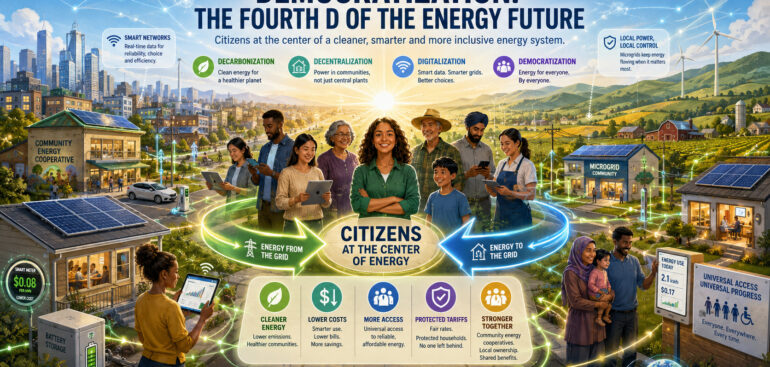
In recent weeks I have addressed three trends of the energy future: decarbonization, decentralization and digitalization. Together these three trends create and reinforce a fourth trend: the democratization of energy, which is the fourth D of the energy future.
Democratization, for the purposes of this article, is not related to the concept of political science that refers to the transition from authoritarian political regimes to democratic ones, but it does take the most important component of the concept of democracy: the citizen who is the center of the democratic process.
A related concept would be the democratization of knowledge, which refers to the process of disseminating knowledge among ordinary people, thereby breaking the concentrations of knowledge enjoyed by elites. Libraries and access to the internet are sources that allow knowledge to be democratized.
In the same way, democratizing energy implies the process of breaking the barriers that prevent universal access to energy and the adaptation of consumption centers into production centers. This implies several things, but the most important is to develop regulation that places the consumer, the user and the citizen at the center.
This means that they are freely allowed to choose their energy provider and their source of generation; that they are allowed to install solar panels on their roofs without the need for complex regulations that benefit horizontally and vertically integrated production chains; and above all it implies that all citizens have access to energy, understanding by this not only electrification but having the capacity to pay or having a protected tariff according to their basic needs.
Just as in political democracy the source of the legitimacy of the ruler is deposited by sovereign citizens as a whole, the energy sector starts from the same logic, from the existence of social demands that are important for the development of a modern energy future for new generations.
This includes decarbonization reflected in a responsible consumption of energy that must consider the least possible impact on the environment. It also includes the breaking of state monopolies and State control in matters of provision of energy services and redesigning its role as regulator and protector of citizens, that is, a process of decentralization.
It also includes taking advantage of the resources that digitalization places within reach of modern societies for the consolidation of a sector that takes advantage of the interconnectivity of consumption centers with production centers and breaks with the limitations of the integration of renewable energies into energy distribution and transmission networks, which must at all times be intelligent.
And, of course, it implies paying attention to the most unprotected, marginalized and vulnerable, to those citizens who do not have access to energy or who have access to energy of lower quality — such as firewood or other solid fuels — or who have access to polluting energy or who, having an electric connection, for example, cannot pay their electricity bills.
The gap in access to energy is the fundamental source of energy poverty and inequality and that has an impact on the quality of life of citizens. In an energy democracy that must matter. The democratization of energy is therefore about bringing more energy at lower prices at lower environmental and social costs and that goes hand in hand with the digitalization, decentralization and decarbonization of the energy sector of the future.
This article was originally published by Business Insider México.
Date: August 5, 2020
Original Link: https://businessinsider.mx/democratizacion-energia-electrica-futuro-energetico-energia-circular-opinion-paul-sanchez/ [offline]
Archived Link: https://web.archive.org/web/20210306234818/https://businessinsider.mx/democratizacion-energia-electrica-futuro-energetico-energia-circular-opinion-paul-sanchez/ [Archived]