
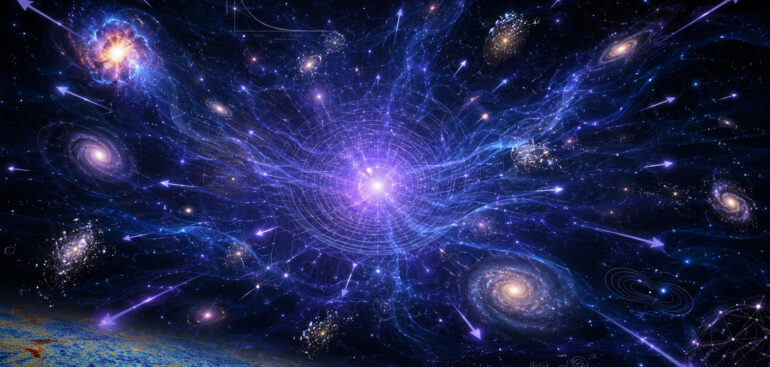
Dark Energy


After a brief interlude, we return to our usual programming. Two weeks ago we talked about the nexus of time and energy and a very particular concept related to this: dark energy, which makes up close to 70% of the total energy of the observable universe.

Dark energy or vacuum energy is underlying background energy that exists in space and expands throughout the entire universe. Said in another way, it is the name that physicists use to define any substance, force or property of space and that have an effect on the universe, causing its expansion to accelerate and, despite everything, we know almost nothing about it.

From the observations of supernovas, it has been hypothesized that the pressure of dark energy is negative, which implies that gravity, instead of a force of attraction as we know it, becomes a force of repulsion.

How to explain dark energy

There are at least three models that seek to explain dark energy. The first explanation is that dark energy is a cosmological constant, a constant that is consistent with Einstein’s equations.

Another current holds that dark energy is not constant but dynamic. This explanation suggests that the density of energy is not constant either in space or in time, in such a way that parameters are established based on the ratios of pressure and density of energy.

A third explanation is derived from the current of quintessence. This current takes the inflationary theories of the universe of scalar fields to solve the initial problems posed by the Big Bang and they were adapted in models to explain observations of the late universe.

In addition to these three currents is that which proposes, as we already indicated, that gravity simply works differently in the universe on large scales. Therefore, as we anticipated, on a large scale gravity would push objects instead of attracting them.

An interesting aspect that has allowed analyzing the dark energy of the universe is the cosmic microwave background radiation that has been theorized, since 1965, is a form of electromagnetic radiation that completely fills the universe. They are considered residual protons that appeared when the universe cooled enough to be neutral.

Undoubtedly, the universe is much more complex than we understand, our understanding of energy is restricted by our scientific progress from the earth. Revealing the secrets of the universe is fundamental for the understanding of energy seen from different perspectives and theories. The approach from quantum science could shed new light regarding energy, space and time; which would allow us, as a society, to advance a little more in the development of new applications that allow us to enter the future in a more audacious way.


This article was originally published by Business Insider México.
Date: February 9, 2021
Original Link: https://businessinsider.mx/energia-oscura-espacio-opinion-paul-alejandro-sanchez-energia-circular/ [offline]
Archived Link: https://web.archive.org/web/20221207124529/https://businessinsider.mx/energia-oscura-espacio-opinion-paul-alejandro-sanchez-energia-circular/ [Archived]
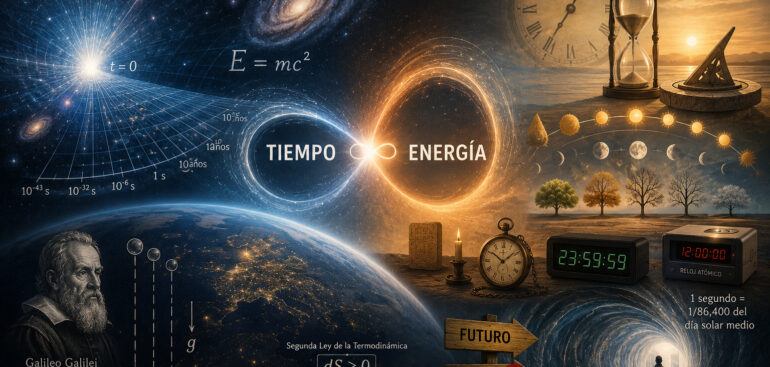
Time and Energy


Time is one of those most primeval, complex, relative, abstract, subjective concepts and in some strange way known by all of us in some form. It is present before us, pardon the redundancy, all the time and it is complicated even to begin to talk about it.

At the origin of everything is the origin of time and I cannot stop asking: if before time, would there be time? In the ontological discussion of time, in the beginning, was everything empty? As if a stopwatch at zero were ready to begin running, waiting for that spark of energy that gave origin to the original movement of the universe. The link seems almost natural, time and energy go together or are they the same thing?

For our earthly scope we think of time in seconds, minutes and hours. The International System of Measures uses the ephemeris second as the basis of the measurement of time in the world and it is equivalent to one in 86,400 seconds that make up a solar day.

Regardless of the society, time has been measured —perhaps with less precision— in the seasons, position of the sun, lunar phases and other mechanisms.

But returning to our analysis, now in more cosmological terms, time and energy are intimately related —it even makes one want to say that they can be the same thing. Some years ago, scientists realized that the universe does not expand at a constant speed, but rather accelerates. For a body to accelerate it requires additional energy to the initial energy. What gives energy to the universe?

One of the most revolutionary discoveries of Galileo Galilei, between 1589 and 1592, was that, regardless of their mass and without resistance, objects fall with the same acceleration product of the force of gravity that gives speed to bodies. That is, that gravity acts as the source of acceleration over bodies.

One hypothesis is that what accelerates the expansion of the universe is something called dark energy, of which we will speak next week, and which is very related to time. Following the postulates of the second Law of Thermodynamics, while time advances the amount of disorder in the universe will increase; given that disorder will increase after something happens, that means, then, that time travels in only one direction.

This is known as the arrow of time and is the basis of the theory that explains that time travel is possible as a jump forward, but never backward. Considering these restrictions, and without entering the field of quantum physics or wormholes, the invention of a time machine would not mean that we could travel to the past, as in “Back to the Future”; but it would be possible to jump in time forward as in “Planet of the Apes.”

Space, and time, run out; however, we will continue next week with these reflections on the nexus of energy and time, exploring the concept of dark energy, and also that of dark matter, which makes up close to 70% of the total energy of the observable universe.

Undoubtedly, we know only the tip of the iceberg of energy in the universe.


This article was originally published by Business Insider México.
Date: January 26, 2021
Original Link: https://businessinsider.mx/tiempo-energia-opinion-energia-circular-paul-alejandro-sanchez/ [offline]
Archived Link: https://web.archive.org/web/20240714005655/https://businessinsider.mx/tiempo-energia-opinion-energia-circular-paul-alejandro-sanchez/ [Archived]