Electricity as a Tax

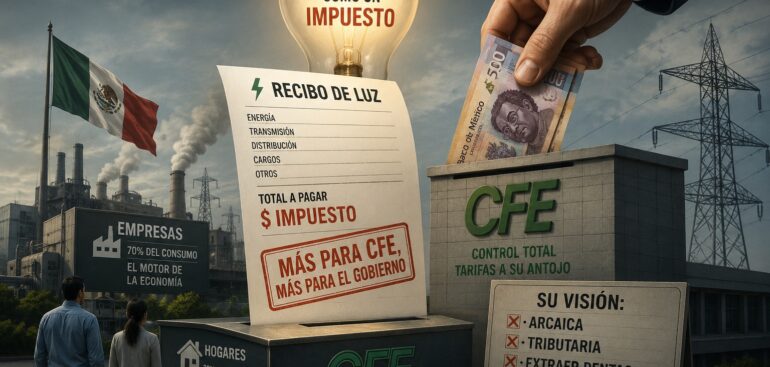
The electric reform presented by the president and that will be discussed this Sunday considers electricity not as a means to generate wealth nor well-being. At the heart of the declarations and intentions lies a painful truth regarding the origin and objectives of the reform: that electricity be a tax paid by Mexican companies and households.

There is a great conceptual confusion that permeates from equating the history of the national electric sector with that of oil, or even mines because of lithium. At the heart of the confusion, a 2.0 nationalization of electricity in the country is intended, but it is forgotten that electricity by itself is not wealth, but rather it is a means that would allow wealth to be generated if used in the correct way.

I reiterate, electricity by itself does not generate wealth, since we cannot generate it, bottle it and export it so that other countries buy it and profits are obtained from its exploitation. Nor can we use it to infinitely increase our well-being, that is, if price did not matter, having six refrigerators turned on does not improve our quality of life.

To the point of absurdity, neither can we use electricity as a force field to avoid invasions and protect national sovereignty from external aggressions. Much less give electricity to families so that they may feed themselves if food is lacking. We cannot use electricity as money, nor save electricity for the future or to relieve economic recessions.

“The vision is not only archaic, but, deep down, it is tributary.”

Electricity is, then, a means, not an end in itself. It is a means that allows us to improve the conditions of households, the lighting of streets, the mobilization of people and the productive activation of factories. Electricity is a means to mobilize and drive the economy; as a country, having an abundance of electricity means that you can offer it to companies so that they generate productive processes.

In Mexico, around 70% of the country’s electric energy is consumed by companies, from small businesses to large industries, and only 25% of consumption is attributable to households. This means that it is of no use to us to have an abundance of electricity if it is not used to strengthen the economy. That is, if tomorrow all companies stop consuming, Mexican households do not benefit; on the contrary, the economy is harmed.

If a country has an abundance of clean and cheap energy, it immediately positions itself as one of the most attractive countries to invest in and that is what generates wealth, not electricity flowing through the networks without being able to be used because companies abandon and stop investing.

The objective of the electric reform is clear and has been reiterated by its defenders on multiple occasions: that industries, businesses and households pay more for electricity, that they pay more to CFE and that CFE obtains control to set the tariffs it wants to whomever it wants and that each and every one of the load centers only buy electric energy from CFE.

The vision is not only archaic, but, deep down, it is tributary, because instead of seeing electricity as a good or service whose purpose is to enable satisfiers and drive economic dynamism, it is only seen as a tax to extract rents from the companies and households that consume the energy. It is simply and plainly about obtaining more cash flow for CFE.


This article was originally published by Energía a Debate.
Date: April 17, 2022
Link: https://energiaadebate.com/la-electricidad-como-un-impuesto/ [Online]

Energy Martyrs

Listening to the arguments of those who are in favor of the electric reform initiative in the open parliaments, I remembered the fable of the horse and the scorpion. The latter, wanting to cross a stream, asks the horse to help him cross. The horse, cautious as equines are, refuses, in the first instance, because the scorpion has a reputation for stinging and killing other animals.

The scorpion, skilled in his words, makes it evident to the horse that if he were to sting him and cause his death while they cross the stream, both would die, for which reason he would not do it. Thus, the horse agrees, the scorpion mounts him and begins his crossing. Halfway through, the horse feels the pain product of the sting.

While he becomes paralyzed and realizes his mistake, before dying the horse questions the scorpion as to why the sting, if now both would die. The scorpion, without philosophical or ontological arguments, without greater reason than instinct, replies only that this is his nature. Thus, both die, the horse and the scorpion.

Before knowing that from the Coordination of Corporate Communication of CFE those who participate in the Open Parliament representing the company have been instructed to concentrate on arguments that appeal to emotions because, from said Coordination, all this is a staging, it was evident that the arguments of those who are in favor of the electric reform initiative followed a certain pattern.

The most worrying of them is that there is not much talk, in the speeches of those who are in favor, about electricity costs going down, but rather all the arguments are concentrated on the supposed injustices that CFE has suffered since 1992, although much is focused on the 2013 reform.

“The central argument is how to increase electricity prices.”

Deep down, what is worrying are the veiled statements of the officials among which stand out that households must pay more for energy, that businesses must pay more for energy and that industrialists must pay more for energy. That is, the central argument is how to increase electricity prices.

To the vehement cry that the provision of the public service does not seek profits, there is indeed advocacy for continuing to increase the monetary flows that go to CFE either through the increase of transmission and distribution tariffs, limiting those who want to install panels on their roofs because they would represent less income for the company, and increasing the amount of energy that comes from CFE by reserving at least 54% of sales, even if the energy comes from more polluting and more expensive sources.

At no time has there been talk about how the cost of electricity can indeed go down, how to reduce labor liabilities, how to make processes efficient, how to integrate new and cheap technologies, how to empower the consumer, how to expand and strengthen the networks. None of that, only how to increase costs.

This is dangerous for the citizenry and harms us all, we are the horse whom the scorpion asks to help him cross, but halfway through, giving everything to CFE is going to cost us all, in price increases, pollutants, job losses and limitations to freedom. This is a reform that only favors CFE and its arguments are not in favor of the benefit of society and, in the end, it will harm us all, including CFE.

If the reform initiative is approved, we will be, then, energy martyrs to sustain the privileges of a company, the State company.


This article was originally published by Energía a Debate.
Date: February 8, 2022
Link: https://energiaadebate.com/martires-energeticos/ [Online]

Be Careful with Energy Consumption


A common concern in times of confinement due to the Covid-19 pandemic is that suddenly CFE has raised energy prices. Although in previous months an X amount equivalent to energy consumption was paid, this has tripled and in some cases quadrupled, without the quantity consumed having increased proportionally. But, I am sorry to disappoint you, on this occasion it is not CFE’s fault, but rather ignorance of the tariff model and the consumption of our homes.

In Mexico the electric tariff of domestic users is controlled, this means that, even if there were a provider different from CFE, it would charge us practically the same. The energy reform sought to open the electric market but not all users have the opportunity to choose their supplier; only large industrial users or large commercial chains. These are called qualified users.

You and I, domestic users, enter into the second category, basic users. The idea is that there would be a type of user with a controlled and flat tariff so that they would always pay the same in their electricity bill and that, eventually, they could change provider by becoming qualified users or be represented by a load aggregator.

The idea of this is that we could play with our consumption and, in some cases, pay less than the controlled or protection tariff. How? For example, if I know that I will leave the city for two weeks, I know that I can pay a lower amount of energy; if I charge my cellphone and computer in the hours of lower demand, my consumption can be lower.

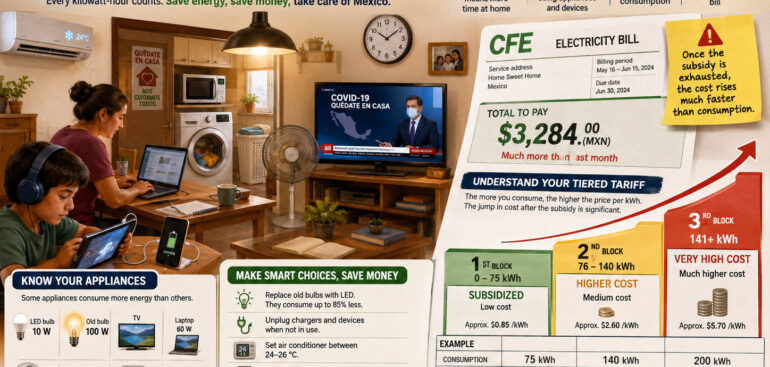
But this that I am telling you is, precisely, the reason behind why many people complain today about exorbitant energy prices. In Mexico, the tariff is tiered, this means that the kWh you consume in the first tier are much cheaper than those of the second tier and those of the third tier, much, but much, more expensive than those of the second tier.

This means that if before you consumed 75 kWh of energy per month, but you and your family spent time away, at school, the office, the cinema or the gym, a relatively low bill always arrived. However, in Mexico City, for example, each additional kWh after 75 costs twice as much as the first 75. In turn, each additional kWh after 140 kWh will cost three times more than the first 75.

By spending more time at home, energy consumption has grown.

In times of confinement, then, people spend more time at home, with the television on, the computer, the lights, the microwave oven; the washing machine, the heating or the air conditioning. The average consumption of households has doubled and this implies that they pay two or three times more because the level of subsidy provided by the State is exhausted.

What can we do? Know your consumption patterns and your appliances. For example, a baby bottle sterilizer consumes 750 W. This means that, using it 15 minutes twice a day in a month, you will consume a little more than 11 kWh —15% of the subsidized tariff in Mexico City. A television consumes 100 W, so having it on 12 hours a day would represent 36 kWh per month, half of your electric subsidy in Mexico City. By the way, if you have any normal 100 W bulb, it is spending the same as an LED TV. What are you waiting for? Change it.

For this reason, in times of pandemic, it is most likely that your consumption has increased and your electric bill comes higher. So be careful with consumption because you could move to the feared Domestic High Consumption tariff, of which I will tell you on another occasion.


This article was originally published by Business Insider México.
Date: October 21, 2020
Original Link: https://businessinsider.mx/cuidado-con-el-consumo-de-energia/ [offline]
Archived Link: https://web.archive.org/web/20240804051440/https://businessinsider.mx/cuidado-con-el-consumo-de-energia/ [Archived]