We arrive at the homonymous column of this space which, since its beginning, has proposed the idea of returning to the future in matters of energy; that is, concentrating public, private and social efforts on analyzing the challenges of the energy sector of the future and potential solutions. We have talked about energy revolutions and what the future may bring us ahead, as well as climate changes and the garbage, and the waste associated with the energy sector.
Since the seventies, the need to implement a sustainable development model has been raised, one that takes into account the use of resources and their replacement rates, in such a way that, in the future, ecosystems can provide the natural resources necessary to give a growing population the means for its continued development.
In 2015, as part of a process to expand the Millennium Goals, the countries that make up the United Nations Organization developed a series of goals related to this topic; it represents the most ambitious expression that the international community has presented, called the Sustainable Development Goals, which is constituted as part of the agenda of the international community of 2030.
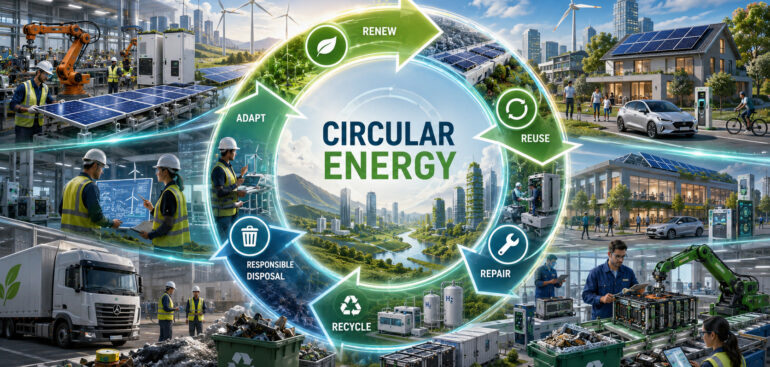
In this sense, one current that proposes an alternative solution for sustainable development is that of “circular economy.” It proposes that the international economic system can reduce waste and the intensive use of resources through the use, reuse, adaptation, repair, recycling and responsible final disposal of goods and products that form part of the supply structure that sustains the world economic base.
Given that world energy development is associated with effects on the environment and, in our times —particularly with climate change caused by greenhouse gas emissions into the atmosphere— it is key to understand how a concept such as “circular energy” can be articulated, incorporating some basic elements of the current into the energy sector.
In this way, even though the future of the energy sector is based on the development of renewable sources —such as solar and wind supported by traditional storage and electric cars, hydrogen for generation, storage or mobility, among other options— this technology needs resources and generates waste that requires special treatment.
Considering this, the challenge to overcome is how to reuse, adapt, repair, recycle or definitively and safely dispose of solar panels, traditional batteries and other clean technologies in such a way that they do not become —just as happened with cellphones and computers— digital garbage.
This is of vital importance, because one of the points established by the 2030 agenda is to guarantee universal access to affordable, reliable and modern energy services. This means that international efforts are aimed at ensuring that the inhabitants of the planet have energy; but also, that this comes from renewable sources and that they are affordable for everyone. This implies, consequently, that it is fundamental to establish mechanisms that lead to a better understanding of what is required to integrate the circular economy model into the energy sector.
This is a debate, which is still in its initial stage, and will be fundamental for the continuous development of the world and to create a green and sustainable energy sector. Otherwise, even with renewable energy sources, we could generate important impacts on the environment.
This article was originally published by Business Insider México.
Date: September 9, 2020
Original Link: https://businessinsider.mx/energia-circular-opinion-paul-sanchez-energia-futuro/ [offline]
Archived Link: https://web.archive.org/web/20240722041425/https://businessinsider.mx/energia-circular-opinion-paul-sanchez-energia-futuro/ [Archived]