Opposite Direction


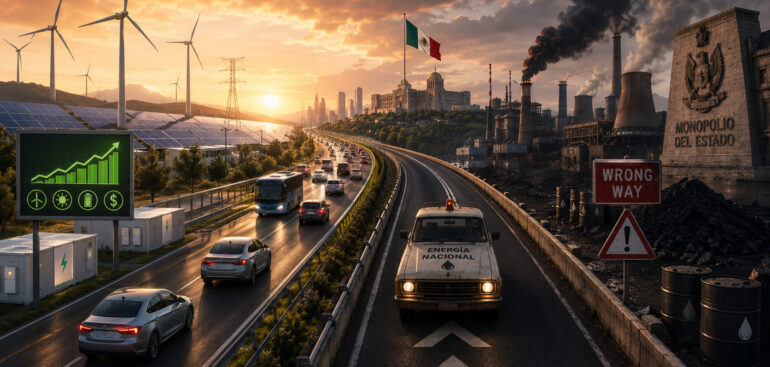
If on a highway all cars are coming in the opposite direction, we probably have to reflect on whether our car is not the one going backwards. In our national energy sector, it is evident that we need to stop and reflect on why we are going in a different direction from the rest of the world.

But first, it is true that we interrupt our usual programming, and I do not forget that we still have pending to talk about dark energy in the universe, the continuation of our previous installment, to talk about more banal topics but that are of great interest to all Mexicans in our day to day: the future of the national electric industry that is about to be defined, at least for the next four years.

This first of February, holiday due to the advance of the 104th anniversary of the Day of the Promulgation of the Political Constitution of the United Mexican States of 1917, the news woke us early, as has been customary, that on Friday the 29th the President of the Republic signed and delivered to the Congress of the Union a preferential initiative to modify the Electric Industry Law.

This is the most recent of a series of attempts that the federal government has made to return the electric sector to a state not only prior to the energy reform, but further back, to 1960 when then-president José Adolfo Mateos nationalized the entire electric industry to turn it into a monopoly operated by a state company, the Federal Electricity Commission (CFE).

In fact, in December 2019, CFE presented a list of demands that outlined this plan and that began with modest actions and omissions, particularly by the Energy Regulatory Commission (CRE) and the National Energy Control Center (Cenace), so that CFE would have a “level playing field,” a euphemism with which it is intended to return to the monopoly. Needless to say, currently, the state company controls more than 80% of the country’s electric generation, more than 80% of consumers; enjoys the monopoly of transmission and distribution, has one of the most important gas pipeline networks in Mexico and receives direct capital injections from the Mexican government.

In times of poor economic performance —in part because of the COVID-19 effect on our lives and because of a series of economic decisions of the current federal administration—, where countries seek to stimulate businesses and companies through support for spending on electric energy; where economic recovery is sought, attracting investment and generating jobs, and where it is sought to paint it as a green recovery, the actions derived from this preferential initiative place us in the opposite direction of the world.

The probability that this course of action will lead us to an imminent collision with other automobiles (countries) or that we come out with permanent damage (loss of competitiveness and country credibility) is high. On the one hand, the statement of reasons clearly dictates, without euphemisms, that the reform to the Electric Industry Law is carried out to strengthen CFE. This goes against the principle of free competition and free concurrence protected in constitutional article 28. Since 2013, generation and commercialization were removed as exclusive monopolies of the State in the Magna Carta to be considered economic activities under the regime of free competition.

Faced with a practice that violates the principles of economic competition that strengthen a State company, we could not rule out that American and Canadian companies are planning to take this issue to a controversy within the T-MEC. With a new government in the United States that actively promotes global decarbonization and the energy transition, then a crash is imminent caused by a vehicle, Mexico, that goes in the opposite direction, thinking that all the others are going in the opposite direction.

The problem is that not only has the driver not realized it, but he thinks that everyone else is the one going backwards. We return to our usual programming next week.


This article was originally published by Business Insider México.
Date: February 3, 2021
Original Link: https://businessinsider.mx/sentido-contrario-cfe-reforma-ley-industria-electica-paul-alejandro-sanchez/ [offline]
Archived Link: https://web.archive.org/web/20221205005654/https://businessinsider.mx/sentido-contrario-cfe-reforma-ley-industria-electica-paul-alejandro-sanchez/ [Archived]
“Are You Still There?”: Why That Screen Appears When No One Is Watching the Series


More than one has done it. We are working, preparing food and we have a Netflix series or some other streaming service in the background. Sometimes we return to watch the program, but other times we continue working, talking on the phone or we even fall asleep while the series runs and runs, functioning as ambient noise. This is not uncommon, it is done a lot and more in these times of working from home. To prevent this from continuing persistently, media companies such as Netflix and YouTube implemented the “Are you still there?” button.

Of course, many of us see this button as a nuisance after the fourth or fifth chapter of your favorite series, when you want to see what happened with the plot after the previous episode. But why is it important? And, above all, what does it have to do with energy, the topic we address in this space.

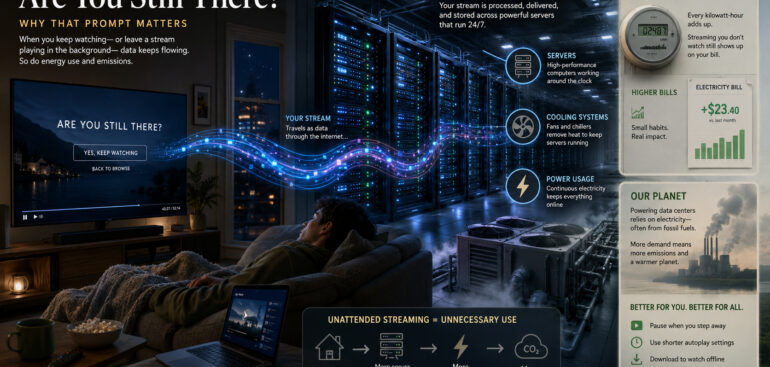
This button exists because if it were not so, we would surely leave the television on ad infinitum. When we addressed the topic of light pollution, we concluded that when the consumption of an additional unit of something does not generate a cost for you, or the cost is not perceived in the short term, the consumer will tend to increase their consumption. But the fact that it does not cost you does not mean that it does not cost YouTube or Netflix for the series to run while you fall asleep.

This is because the series of these platforms rest on servers that require energy to be available at all times. And, the greater the intensity of consumption, the more intensity of processing is generated, which requires more energy, on the one hand —because the server is in active operation all the time—; on the other hand, because they generate heat that requires more energy to keep the rooms where said servers are cold.

In recent years two phenomena have occurred; the first, the energy consumption of the cloud, that is, the servers of data companies such as Google, Microsoft, Netflix; Amazon and Dropbox, among others, has increased. Nevertheless, the second effect is that energy consumption has become more efficient per unit of work performed. This means that every day more energy is consumed to maintain digital services in the cloud, although much progress has been made in energy efficiency.

In that sense, the idea behind the “Are you still there?” button is not because Netflix cares about you, it is a measure of consumption efficiency and, at the end of the day, of energy efficiency. This is because if all of us left series running all the time, surely the company’s energy consumption would increase.

But not only that, greenhouse gas emissions would also increase, both those that you cause through the consumption of your series at home, and those of the company for keeping its servers operating in an inefficient way while no one is watching TV. We will go deeper into that next week.

However, not everything is bad, this could also be good for you. Because to the extent that you are more conscious of your energy consumption at home, you will avoid surprises in your electricity bill every two months, with which you save electricity and contribute to mitigating climate change.

So remember, if you have the habit of waiting until the server asks you “Are you still there?” and you are really not paying attention to the series that runs incessantly, perhaps it is time to rethink your energy consumption for the good of the planet and of your pocket.


This article was originally published by Business Insider México.
Date: November 11, 2020
Original Link: https://businessinsider.mx/sigues-ahi-boton-ver-series-netflix-streaming-opinion-energia-circular/ [offline]
Archived Link: https://web.archive.org/web/20211204081743/https://businessinsider.mx/sigues-ahi-boton-ver-series-netflix-streaming-opinion-energia-circular/ [Archived]

Be Careful with Energy Consumption


A common concern in times of confinement due to the Covid-19 pandemic is that suddenly CFE has raised energy prices. Although in previous months an X amount equivalent to energy consumption was paid, this has tripled and in some cases quadrupled, without the quantity consumed having increased proportionally. But, I am sorry to disappoint you, on this occasion it is not CFE’s fault, but rather ignorance of the tariff model and the consumption of our homes.

In Mexico the electric tariff of domestic users is controlled, this means that, even if there were a provider different from CFE, it would charge us practically the same. The energy reform sought to open the electric market but not all users have the opportunity to choose their supplier; only large industrial users or large commercial chains. These are called qualified users.

You and I, domestic users, enter into the second category, basic users. The idea is that there would be a type of user with a controlled and flat tariff so that they would always pay the same in their electricity bill and that, eventually, they could change provider by becoming qualified users or be represented by a load aggregator.

The idea of this is that we could play with our consumption and, in some cases, pay less than the controlled or protection tariff. How? For example, if I know that I will leave the city for two weeks, I know that I can pay a lower amount of energy; if I charge my cellphone and computer in the hours of lower demand, my consumption can be lower.

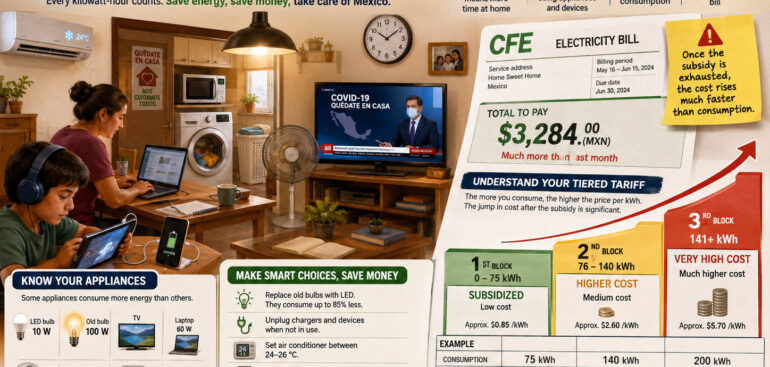
But this that I am telling you is, precisely, the reason behind why many people complain today about exorbitant energy prices. In Mexico, the tariff is tiered, this means that the kWh you consume in the first tier are much cheaper than those of the second tier and those of the third tier, much, but much, more expensive than those of the second tier.

This means that if before you consumed 75 kWh of energy per month, but you and your family spent time away, at school, the office, the cinema or the gym, a relatively low bill always arrived. However, in Mexico City, for example, each additional kWh after 75 costs twice as much as the first 75. In turn, each additional kWh after 140 kWh will cost three times more than the first 75.

By spending more time at home, energy consumption has grown.

In times of confinement, then, people spend more time at home, with the television on, the computer, the lights, the microwave oven; the washing machine, the heating or the air conditioning. The average consumption of households has doubled and this implies that they pay two or three times more because the level of subsidy provided by the State is exhausted.

What can we do? Know your consumption patterns and your appliances. For example, a baby bottle sterilizer consumes 750 W. This means that, using it 15 minutes twice a day in a month, you will consume a little more than 11 kWh —15% of the subsidized tariff in Mexico City. A television consumes 100 W, so having it on 12 hours a day would represent 36 kWh per month, half of your electric subsidy in Mexico City. By the way, if you have any normal 100 W bulb, it is spending the same as an LED TV. What are you waiting for? Change it.

For this reason, in times of pandemic, it is most likely that your consumption has increased and your electric bill comes higher. So be careful with consumption because you could move to the feared Domestic High Consumption tariff, of which I will tell you on another occasion.


This article was originally published by Business Insider México.
Date: October 21, 2020
Original Link: https://businessinsider.mx/cuidado-con-el-consumo-de-energia/ [offline]
Archived Link: https://web.archive.org/web/20240804051440/https://businessinsider.mx/cuidado-con-el-consumo-de-energia/ [Archived]