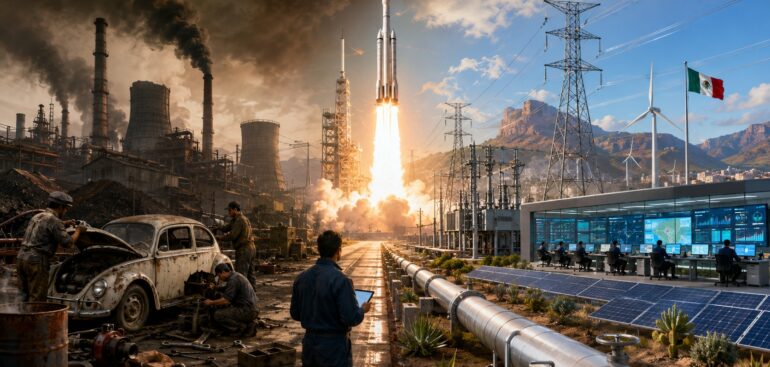
They were building a Ferrari for every launch, when it was possible that a Honda Accord could achieve it.
– Elon Musk
On May 30, the first private space mission was launched by Elon Musk’s company SpaceX, also founder of Tesla, which sent two NASA astronauts to the International Space Station. This launch represents the first trip departing from the United States in almost a decade and represents what some call the beginning of the private space race. Can this teach us some lessons for CFE?
It would be difficult for us to think of an area more strategic for a government than its space program, and even more so when it is intimately linked with an arms and ideological race before the perceived threat in times of the Cold War. And as such, it received large sums of public budget to operate.
However, in the more than 60 years since its creation, the world has changed a lot in political, economic and social aspects. The model of the welfare State was becoming exhausted, mainly because of the amount of resources required to sustain the government structure, and with it the large sums that governments could dedicate to these strategic sectors.
For example, NASA’s budget went from 43,554 million dollars to 22,559 million dollars between 1966 and 2020, in constant 2014 dollars. As a consequence, the agency has had to close some of its most emblematic programs, such as the manned space shuttle program that operated for 30 years from 1981 to 2011. In total, through this program, 135 trips were carried out that had a launch cost of between 450 and 1,500 million dollars.
The most important lesson from the SpaceX Dragon launch is that it cost 50 million dollars, only 10% of the cost of the cheapest launch of NASA’s space shuttles, in such a way that the agency has decided to become one of the company’s main clients to send astronauts into space.
That is, NASA continues developing strategic activities in space matters and dedicates its resources and efforts where it could obtain more value for the country and the world, such as the remote exploration of Mars, Jupiter and Saturn and the exploration of deep space with its space satellites, and leaves to private initiative the launches that can be done more economically for the agency.
Seen in this way, CFE could learn a lot from NASA, concentrating on the strategic areas that generate more value per unit of investment, such as transmission, distribution, telemetry, transportation and commercialization of natural gas, among others, and leaving behind those volumetric goals of electric energy generation that require keeping expensive, inefficient and polluting plants in operation, such as those that operate with fuel oil and coal, replacing that generation with clean and renewable energy at low costs like those obtained in the Long-Term Auctions for the benefit of our health and our pockets.
Who knows? Perhaps instead of trying to continue repairing the mythical Vocho with a Ferrari budget, CFE could achieve more, much more, for all Mexicans, just as NASA did.
This article was originally published by Business Insider México.
Date: June 3, 2020
Original Link: https://businessinsider.mx/lo-que-la-nasa-puede-ensenarle-a-cfe-opinion-paul-alejandro-sanchez-energia-circular/ [offline]
Archived Link: https://web.archive.org/web/20210117004053/https://businessinsider.mx/lo-que-la-nasa-puede-ensenarle-a-cfe-opinion-paul-alejandro-sanchez-energia-circular/[Archived]