
“The next energy miracle is nuclear energy”
– Bill Gates
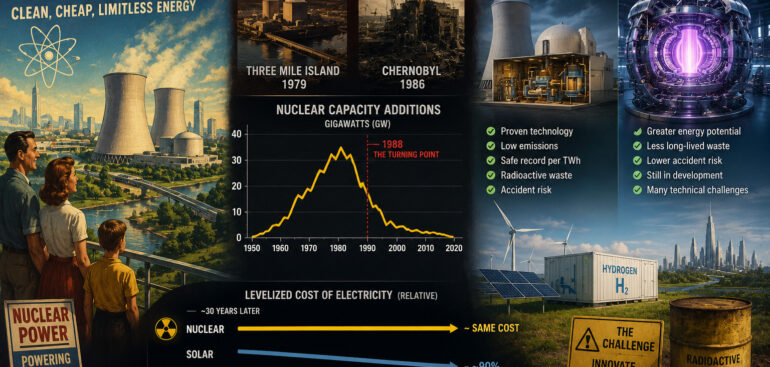
Back in the 1950s, nuclear energy was the promise of a bright future based on cheap and non-polluting energy. But the dream was cut short, mainly because of the bad press derived from catastrophic events such as Three Mile Island in the United States in 1979 and Chernobyl, in Soviet Ukraine in 1986.
Despite this, nuclear plants maintain the lowest rate of deaths and greenhouse gas emissions per energy generated among thermal technologies. That is to say that generation with coal, oil, natural gas and even hydroelectric plants have caused more accidents and deaths per unit of energy generated.
The nuclear boom occurred between the 1950s and 1980s and practically stopped in 1988 only to decrease in the 2010s. In comparison, while the costs of renewable energies have decreased at dramatic speeds, more proven technologies such as combined cycle turbines or internal combustion engines have also improved their costs and efficiencies. The above mainly because innovation and technological development, as well as strong competition, have not stopped.
However, for nuclear power plants it has been 30 years and the leveled costs have remained practically at the same levels because the memory of nuclear accidents is there. And as the years passed, the technological development of nuclear plants stagnated.
Now then, it is worth pointing out that when we talk about nuclear plants, in general, there are two ways to generate electricity: atomic fission and atomic fusion. The first is the only one that has been developed commercially and it is of which we have been talking up to this point. The second, for its part, remains in development in the international community and represents the possibility of a second wind for nuclear power plants.
Nuclear fission is the generation of a massive amount of energy due to the division of an atom. The most common nuclear fuels are the isotopes uranium-235 and plutonium-239. In a nuclear plant, the kinetic energy released by these materials is converted into heat that heats a fluid, normally water, which becomes heat and moves a turbine that produces the energy.
Nuclear fusion, for its part, is the inverse process. A great amount of energy is generated by the union of two or more atomic nuclei to form a different atomic nucleus or other subatomic particles. Fusion reactions have much greater energy density than fission reactions and with this they can produce electricity with the same principle as fission.
Atomic fusion has advantages over nuclear fission, particularly in that it can generate greater energy and emit less toxic waste, lower radioactivity and the risks of an accident of similar magnitude to those of Chernobyl or Fukushima are lower, which is why the scientific community seeks to achieve an advance to produce clean and cheap energy through nuclear fusion.
But there is always a “but.” What stops the progress of nuclear fusion? As I pointed out at the beginning, since the scientific and technological development of nuclear energy stopped for almost 30 years, the budget has been insufficient and companies and governments have decided to focus on other areas such as renewables, storage and hydrogen. This makes it very unlikely that, in the future, we will see a commercially viable nuclear fusion power plant because time does not forgive and the promise of a nuclear future will remain only in those movies of the 1960s.
This article was originally published by Business Insider México.
Date: October 14, 2020
Original Link: https://businessinsider.mx/que-paso-energia-nuclear-plantas-nucleares-opinion-paul-alejandro-sanchez-energia-circular/ [offline]
Archived Link: https://web.archive.org/web/20240723112519/https://businessinsider.mx/que-paso-energia-nuclear-plantas-nucleares-opinion-paul-alejandro-sanchez-energia-circular/ [Archived]