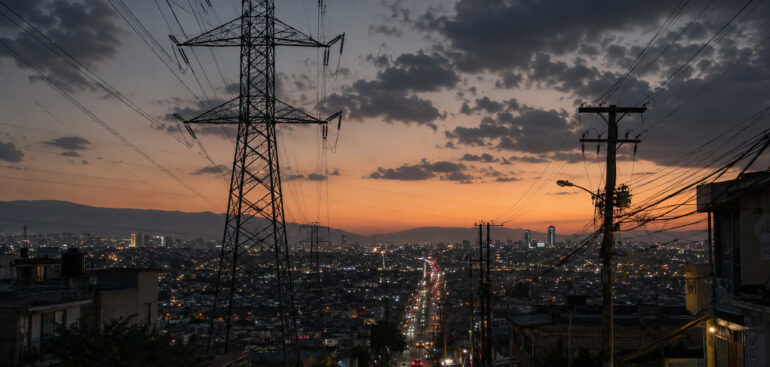
During June 2026, interruptions, voltage fluctuations, and power outages were reported in at least 20 states. The government insisted that they were not blackouts because generation capacity existed, although the explanation confirms the most important problem in the system. Mexico can produce electricity and still fail to deliver it when the transmission and distribution networks become saturated.
The 2013 reform started from two lags: power plants were lacking and the grid was lacking. Electricity generation was opened to competition and attracted private developers willing to build new capacity. Transmission and distribution remained strategic activities of the State because they are natural monopolies. Duplicating lines, substations, and circuits to create competition would be inefficient, while a single operator can take advantage of economies of scale if it is subject to regulated tariffs, open access, and clear expansion obligations.
CFE thus received an activity protected from competition, with relatively stable revenues coming from the use of the grid by public and private power plants. Those resources were supposed to recover investment, operation, maintenance, and depreciation, in addition to financing new projects. The public monopoly made economic sense as long as financial stability was transformed into additional capacity to bring electricity to users.
The previous administration shifted that priority toward the ownership of power plants. It allocated around 6 billion dollars to purchase existing plants and restricted new private projects, while grid projects accumulated delays. The framework derived from the 2024 constitutional reform consolidated that logic by establishing that the State must maintain 54% of generation, although that percentage does not determine whether a substation is saturated, whether a transformer can withstand the load, or whether a city can receive energy during a heat wave.
The problem appears more clearly in summer. Average demand may grow moderately, but the grid must respond to the peak in consumption that occurs when thousands of households and businesses simultaneously turn on air-conditioning equipment. That pressure is concentrated in specific regions, schedules, and circuits, especially in distribution. Having power plants available in another area of the country does not solve a local constraint when lines, feeders, or transformers are lacking.
Binding planning should focus on that infrastructure, where the State is irreplaceable. Recent calls showed that there is private interest in building generation, but in the grids, no one can replace public execution. Artificially maintaining a State participation of 54% addresses a discussion about ownership, while expanding transmission and distribution addresses the real reliability of the system.
When temperatures fall toward autumn, interruptions will decrease and so will political attention. The pressure will return next summer, probably with higher nighttime demand and higher temperatures. By then, the system will be evaluated by the lines, substations, and transformers that have effectively entered into operation and not by the amount of sovereign energy that makes up the country’s electricity supply.
This article was originally published by La Prensa OEM.
Date: July 19, 2026
Link: https://oem.com.mx/la-prensa/analisis/opinion-por-paul-alejandro-los-apagones-y-la-red-rezagada-31171733 [Online]