The Tax on Energy in the Future


In a very reductionist way, the origin of States implies a social contract where citizens choose to form a government that maintains order and fulfills other obligations for their benefit. To achieve this, human and material resources are required that must be covered with economic resources. Said in another way, governments need money to fulfill their tasks.

Governments have very limited ways of obtaining money. The most important and central one is taxes. That is, the imposition of participatory quotas on citizens, whether as individuals or as corporations, to maintain the actions of the government. The greater the tax burden, the more activities the government can develop optimally. However, it is a widely accepted consensus that citizens do not like paying taxes.

Another way in which governments can obtain income is through public debt, which is nothing other than obtaining money in advance that, in the end, will have to be paid with the government’s own income in the future. Debt is also very unpopular and dangerous because resources are committed in the long term to maintain payment to creditors.

In Mexico, however, an important part of public spending depends on two sources: oil revenues from the product of the sale of crude oil and taxes on fuels. As part of flexibility strategies, the Mexican government established a strategy based on establishing incentives when the price of gasoline was high, which were absorbed, in some way, by oil exports.

In recent years, the price of oil had remained relatively low —below 50 dollars per barrel— so, to maintain public revenues when the price of crude oil was low, the incentive to gasoline was reduced. This helped maintain the income not obtained from the sale of crude oil.

Consider that the use of oil causes serious problems related to climate change. Therefore, one of the logics of taxing fossil fuels is to dissuade their use in the long term to avoid their negative externalities or else to develop policies that allow correcting the consequences; for example, to adapt societies to climate change.

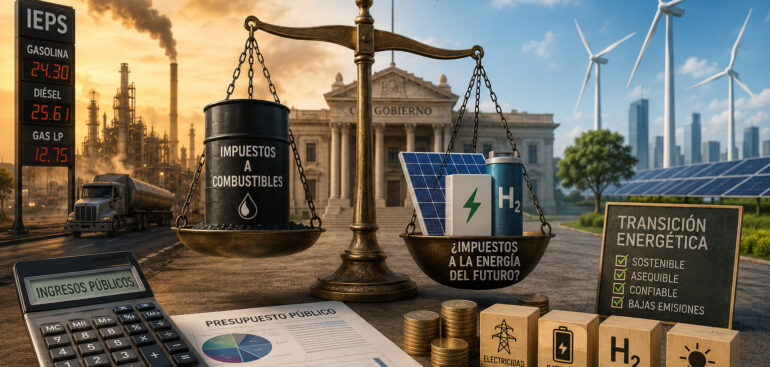
However, if one of the trends in the future is decarbonization, that would mean that taxes on fuels could disappear; with this, government revenues would decrease. Then, if fossil fuels are replaced by renewable sources of energy, how could said income be recovered?

Some proposals that have been debated in some countries regarding this topic are to tax, for example, electricity, batteries or even hydrogen. The logic behind these new levies would not be externalities, but collection itself.

Then, it would be possible that in the future, we see an IEPS on electricity, which by the way, this possibility has been established in the Constitution for some years. Perhaps, then, we could see taxes on the sun as in Spain some years ago or perhaps taxes on hydrogen as were recently approved in Argentina.

The challenge is that these taxes be progressive and that they do not condition the energy transition; at the same time that they allow governments to obtain the necessary resources for their continuous operation in the long term. For the moment, let this text serve to encourage the debate regarding the tax on energy in the future.


This article was originally published by Business Insider México.
Date: January 19, 2021
Original Link: https://businessinsider.mx/impuesto-energia-mexico-futuro-opinion-paul-sanchez-energia-circular/ [offline]
Archived Link: https://web.archive.org/web/20240222173025/https://businessinsider.mx/impuesto-energia-mexico-futuro-opinion-paul-sanchez-energia-circular/ [Archived]

The Waste of the Present


“Our use of fossil sources pushes us to a point of no return.”

– Barack Obama

The massification of the automobile allowed an energy transition, particularly of the energy used for mobility. This allowed solving complicated public problems that the great cities of that time, such as New York and London, faced because of the waste of horses, the main means of transportation of that time, in the form of manure, urine and corpses.

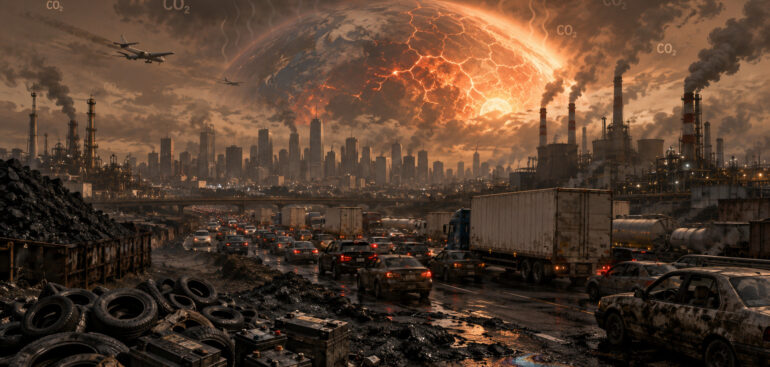
However, despite the problems it solved, the adoption of new forms of energy and technologies brought with them their own problems. Although the waste of today, related to fossil sources, is multivariate and presents its own challenges, for example, used tires, batteries, coal mining or the used automobiles themselves, its most characteristic byproduct is greenhouse gas emissions.

The massification of the automobile and the development of electric plants based on fossil sources such as mineral coal and petroleum derivatives generated an increase in the emission of greenhouse gases, which made evident a series of social and environmental problems.

Global warming began to gain relevance in the world starting in the 1990s, particularly with the Earth Summit in Rio de Janeiro, Brazil, in 1992. The topic addressed particularly was the link between greenhouse gas emissions with the use of fossil sources of energy, with global warming, and the latter with climate change.

By the 1900s, the increase in the temperature of the Earth had been 0.2 degrees Celsius; with the massification of automobiles in the 1950s, an increase of 0.5 degrees Celsius was reached compared with the average temperature of the second half of the nineteenth century. By the year 2000, it had already reached 0.7 degrees and in 2018–2019 an increase of 1.2 degrees Celsius.

Undoubtedly, the economic, scientific, technological and social development of the world is intimately linked to a greater availability of energy, which opened a world of possibilities to expand the frontier of expansion of the global economy at an important cost: climate change.

It would not be fair to say that there were alternatives because, as I indicated in last week’s article, in the past there were also environmental impacts that were unsustainable in the long term. However, it is important to note that it is this public problem of global character that is the main reason why the international community has pressed for an accelerated energy transition based on the decrease in the intensity of the use of fossil sources of energy and greater use of renewable energy sources and storage.

Many solid advances have been made along that path; solar and wind have now contributed 10% of the energy consumed in the world, while generation based on mineral coal has lost almost the same amount, 8% in the same period, in such a way that it is not impossible to think that in a not very distant future we could see its replacement as a primary source of energy.

However, renewable and green sources, storage, electric automobiles, hydrogen and other technologies that are defining the future of energy, do they not generate waste, refuse or residues of some kind? The answer is yes, and just as in the past the horse generated an impact on the environment and today fossil sources do as well, it is a fact that in the future, energy waste will also change and we will talk about that next week. Until then.


This article was originally published by Business Insider México.
Date: August 19, 2020
Original Link: https://businessinsider.mx/basura-del-presente-energia-circular-opinion-paul-alejandro-sanchez/ [offline]
Archived Link: https://web.archive.org/web/20210306233903/https://businessinsider.mx/basura-del-presente-energia-circular-opinion-paul-alejandro-sanchez/ [Archived]

Game Theory and Oil-Producing Countries

Last Saturday we witnessed another meeting of the Organization of Petroleum Exporting Countries and its allies (OPEC+). This organization is what economists refer to as a cartel or an oligopoly with cooperative strategies. In other words, it is a group of producers cooperating to influence prices, primarily by reducing production in order to increase prices from the supply side for the benefit of cartel members.

It sounds simple, but it is not. As a result, it has become one of the classic cases studied in game theory, a discipline that examines the strategic interaction of rational decision-makers. Game theory has been applied in fields such as biology, computer science, and the social sciences, particularly economics, which is where we will focus our attention.

The logic of a cartel suggests that if all participants agree to reduce production and maintain a target price, everyone benefits from higher oil prices. As a result, producers can earn greater revenues with lower output and higher prices. However, while this may be the socially optimal solution for participants, it is not the dominant strategy.

For any country within OPEC+, the dominant strategy is for all other members to reduce production and raise market prices while it does not. In that scenario, prices increase while that country produces more and sells at higher prices. Consequently, the dominant strategy for each individual country is to defect while everyone else cooperates.

Imagine a group of friends agreeing to split a restaurant bill equally. The socially efficient outcome would be for everyone to order similar meals and pay similar amounts. However, knowing that the cost will be shared, one person’s incentive is to order the most expensive item on the menu and distribute the cost among everyone else. If everyone thinks this way, the final bill becomes so high that everyone pays more, or those who ordered less feel the arrangement is unfair. If this behavior becomes repetitive, the group may eventually decide that each person should pay only for what they consume.

For this reason, a successful cartel requires certain conditions: a limited number of producers, transparent reference prices, relatively homogeneous goods, barriers to entry for non-members, and a credible threat of punishment for members who fail to cooperate.

These conditions are increasingly difficult to achieve because, in recent years, the number of countries outside OPEC+ that nevertheless contribute significant production to international markets has grown considerably. In particular, the United States, Canada, Brazil, Norway, and the United Kingdom together account for more than 20 percent of global oil production.

As a result, the price targeted by OPEC+ must be high enough to incentivize its members while remaining low enough to discourage non-members. If oil prices remain above USD 40 per barrel, it is only a matter of time before independent producers in the United States, for example, begin flooding the market once again, forcing additional production cuts and making cooperation among OPEC+ members increasingly difficult.

If game theory teaches us anything, it is that coordinating oil-producing countries around a long-term strategy becomes extremely challenging when a significant portion of global production remains outside the agreement or is willing to refuse cooperation over the long run, as is the case with countries such as Mexico. Under such circumstances, maintaining a coordinated strategy is unlikely to be sustainable for very long.


This article was originally published by Business Insider México.
Date: June 10, 2020
Original Link:https://businessinsider.mx/teoria-de-juegos-en-los-paises-petroleros-opinion-energia-circular-paul-alejandro-sanchez/ [offline]
Archived Link: https://web.archive.org/web/20240225023731/https://businessinsider.mx/teoria-de-juegos-en-los-paises-petroleros-opinion-energia-circular-paul-alejandro-sanchez/[Archived]