
Those who follow Formula 1 will have seen that last Sunday at the Bahrain Grand Prix, the French driver Romain Grosjean suffered a spectacular accident. To his good fortune, he did not suffer serious injuries, but the flames of the accident inspired me for this column.
In one maneuver, Grosjean crashes into the containment wall, splitting the car in half and immediately causing an explosion. The flames were impressive; however, in seconds the F1 team was trying to put out the fire and open a space so that the driver could get out from among the flames. No more than 30 seconds passed between the impact and Grosjean’s exit.
We are used to seeing these scenes: after an accident, a conventional car runs the risk of catching fire. Normally, we see that water or chemical extinguishers are used to put out the fire. What this seeks is to isolate the fuel to control the fire and prevent another one from starting. But electric cars bring their own challenges and this works differently.
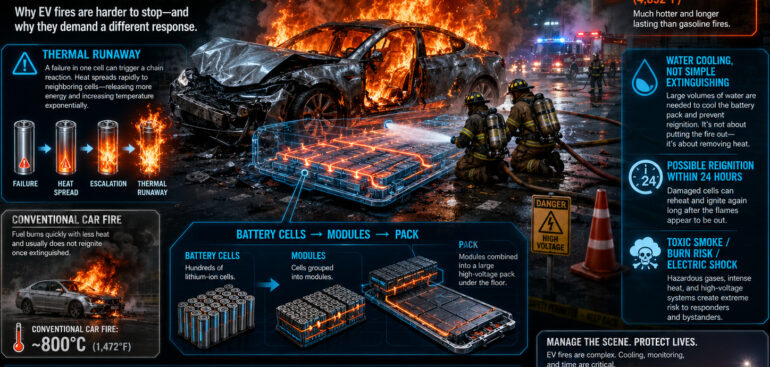
A conventional electric car could require up to 1,125 liters of water per minute and up to 24 hours to be extinguished. Why? Well, basically, because the fire of a lithium battery in electric cars cannot be extinguished; it will continue until all the cells are consumed.
The batteries of electric cars are composed of many cells that are grouped into modules and, in turn, into packs. The batteries of electric cars can have one or several packs and, in the event of a short circuit, the fire can reach a temperature of 2,700 degrees Celsius. To give you an idea, the fire of a conventional car is 800 degrees Celsius, that is, a fire of an electric car is three times more intense.
Once at the place, the protocol changes. What is sought is not to put out the fire but to reduce the heat enough to be able to activate the mechanisms that separate the modules and avoid a chain reaction and, at the same time, remove other objects at risk, for example, nearby cars in a parking lot. If this is not possible, the car will continue burning for approximately 24 hours.
Water extinguishers are the tool of choice because of the way the chain reaction of the fire in the battery pack works. However, it must be used following certain precautions because, given the heat, water can separate into its components, oxygen and hydrogen, causing a violent flare-up by providing the combustion with more oxidizing agent.
But it does not end there; there are other associated risks: electric shock, heat burns, chemical burns, toxic smoke. The worst? If the dismantling protocols are not followed to stop the chain reaction, the battery could catch fire again in a period no longer than 24 hours.
The accident in Formula 1 demonstrates the technological, safety and protocol advances that we have in fires of conventional cars. But electric cars change the game; if the car that Grosjean crashed had been electric, perhaps the result would not have been so favorable.
As electric cars become widespread and become the rule, the challenge of electric car fires will increase, but this period represents the most complicated learning curve for all countries. In Mexico, we are still in time to begin designing the necessary protocols to prepare ourselves for this new reality and include the large batteries of mass transport.
This article was originally published by Business Insider México.
Date: December 2, 2020
Original Link: https://businessinsider.mx/autos-electricos-accidentes-llamas-opinion-energia-circular-paul-sanchez/ [offline]
Archived Link: https://web.archive.org/web/20240715042612/https://businessinsider.mx/autos-electricos-accidentes-llamas-opinion-energia-circular-paul-sanchez/ [Archived]