
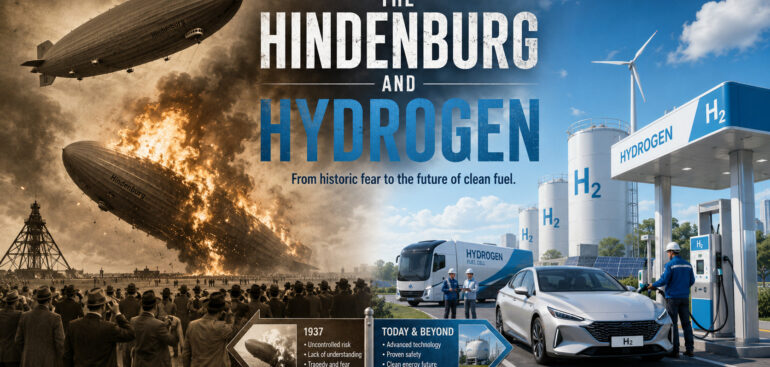
There was a time, before the Second World War, when air transport was dominated by zeppelins —which are basically self-propelled aerostats that remained in the air thanks to being filled with hydrogen, which, being lighter than oxygen, allowed aerostatic lift. Also known as dirigibles, zeppelins had as their basic principle a rigid structure that supported the walls of the balloon where the hydrogen was located.
Since the 1890s, Count Ferdinand von Zeppelin began the development of the rigid dirigible that, finally, bore his name and was completed in 1900. The LZ-1, as the first zeppelin was called, measured 128 meters long.
The first airline in the world, DELAG, operated seven zeppelins in 1914. By then it had already transported almost 35,000 passengers on more than 1,500 commercial flights, accumulating more than 170,000 kilometers and more than 3,000 hours of travel. The First World War stopped the advance of commercial flights, since the German army took DELAG’s aircraft to use them in combat.
By the end of the war, the British developed their own zeppelins, with the R34 being the first to cross the Atlantic in July 1919. After several attempts, in 1931, DELAG —using the LZ-127 of the Zeppelin company— launched several national, regional and transatlantic routes; there was even a route between Germany and South America. At that time, zeppelins were far ahead of the capabilities of airplanes; by 1937, around 140 transatlantic trips and a complete trip around the world in an airship had been made.
However, in 1937 the future of zeppelins ended in tragedy with the Hindenburg disaster. On May 6, the German aircraft LZ-129 of the Hindenburg class caught fire in New Jersey, United States. Of the 97 people on board, among passengers and crew members, 35 died.
Although there are different theories regarding the cause of the tragedy, the dominant one indicates that a spark caused by static provoked a chain reaction that, due to the large amount of hydrogen inside the zeppelin, caused it to ignite and magnified the tragedy.
Hydrogen is highly flammable and is considered a high-power fuel that burns at high speed and with great force. It is normally used in industries that require high power, such as aerospace, particularly in rocket launches.
Despite the fact that incidents related to hydrogen, such as that of the Hindenburg, have had great relevance, in reality hydrogen as a fuel is potentially safer than petroleum derivatives such as gasoline and diesel. When these petroleum products spill and ignite, it is highly probable that the fire will last a considerable time. In contrast, in an accident related to hydrogen, it tends to disperse quickly, rising at a speed of 72 kilometers per hour into the atmosphere; in case of fire, the fire generated has less heat because of the absence of carbon, so it goes out quickly.
The lesson of the Hindenburg was not the colossal impact for the time derived from its fire, but rather that, in reality, it demonstrated that hydrogen, although more unstable, can be safer. In that sense, there remains an important area of opportunity before speaking of hydrogen service stations and hydrogen automobiles: increasing the safety associated with its storage and distribution, much of which has been learned thanks to the development of the conventional automobile industry.
This article was originally published by Business Insider México.
Date: December 9, 2020
Original Link: https://businessinsider.mx/hindenburg-accidentes-hidrogeno-combustible-opinion-energia-circular/ [offline]
Archived Link: https://web.archive.org/web/20240424101358/https://businessinsider.mx/hindenburg-accidentes-hidrogeno-combustible-opinion-energia-circular/ [Archived]