
The Tax on Energy in the Future


In a very reductionist way, the origin of States implies a social contract where citizens choose to form a government that maintains order and fulfills other obligations for their benefit. To achieve this, human and material resources are required that must be covered with economic resources. Said in another way, governments need money to fulfill their tasks.

Governments have very limited ways of obtaining money. The most important and central one is taxes. That is, the imposition of participatory quotas on citizens, whether as individuals or as corporations, to maintain the actions of the government. The greater the tax burden, the more activities the government can develop optimally. However, it is a widely accepted consensus that citizens do not like paying taxes.

Another way in which governments can obtain income is through public debt, which is nothing other than obtaining money in advance that, in the end, will have to be paid with the government’s own income in the future. Debt is also very unpopular and dangerous because resources are committed in the long term to maintain payment to creditors.

In Mexico, however, an important part of public spending depends on two sources: oil revenues from the product of the sale of crude oil and taxes on fuels. As part of flexibility strategies, the Mexican government established a strategy based on establishing incentives when the price of gasoline was high, which were absorbed, in some way, by oil exports.

In recent years, the price of oil had remained relatively low —below 50 dollars per barrel— so, to maintain public revenues when the price of crude oil was low, the incentive to gasoline was reduced. This helped maintain the income not obtained from the sale of crude oil.

Consider that the use of oil causes serious problems related to climate change. Therefore, one of the logics of taxing fossil fuels is to dissuade their use in the long term to avoid their negative externalities or else to develop policies that allow correcting the consequences; for example, to adapt societies to climate change.

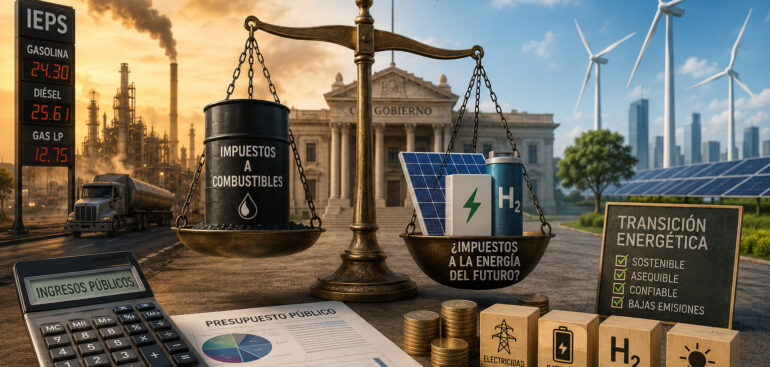
However, if one of the trends in the future is decarbonization, that would mean that taxes on fuels could disappear; with this, government revenues would decrease. Then, if fossil fuels are replaced by renewable sources of energy, how could said income be recovered?

Some proposals that have been debated in some countries regarding this topic are to tax, for example, electricity, batteries or even hydrogen. The logic behind these new levies would not be externalities, but collection itself.

Then, it would be possible that in the future, we see an IEPS on electricity, which by the way, this possibility has been established in the Constitution for some years. Perhaps, then, we could see taxes on the sun as in Spain some years ago or perhaps taxes on hydrogen as were recently approved in Argentina.

The challenge is that these taxes be progressive and that they do not condition the energy transition; at the same time that they allow governments to obtain the necessary resources for their continuous operation in the long term. For the moment, let this text serve to encourage the debate regarding the tax on energy in the future.


This article was originally published by Business Insider México.
Date: January 19, 2021
Original Link: https://businessinsider.mx/impuesto-energia-mexico-futuro-opinion-paul-sanchez-energia-circular/ [offline]
Archived Link: https://web.archive.org/web/20240222173025/https://businessinsider.mx/impuesto-energia-mexico-futuro-opinion-paul-sanchez-energia-circular/ [Archived]
The Race of the Artificial Suns


The energy transformation of our times advances, in a discreet way but at a good pace. There are several races that seek to break with the current limits of technologies; they can become the dominant standard of the global energy sector in the future.

Recently, GE launched the Haliade-X, a 13 MW mega wind turbine that makes the 2.5 MW turbines in La Venta, Oaxaca pale. We can see the same with technological companies that seek to integrate perovskite into solar panels to make them more efficient; batteries with greater duration, cheaper and more compact, among many other events. But a technological race to which we should pay special attention is that of artificial suns.

But what is an artificial sun?

In reality it is an apparatus that uses high-temperature plasma superconducting technology and high magnetic fields to approach atomic fusion, similar to what happens inside a sun. To achieve this, the fusion fuel must be heated to temperatures of more than 200 million degrees Kelvin, where matter becomes plasma.

Before fusion occurs, the electric repulsion of the atomic nucleus allows the atoms to come physically close enough to fuse. Fusion, then, promises the use of this reaction to provide virtually unlimited, safe energy with zero greenhouse gas emissions.

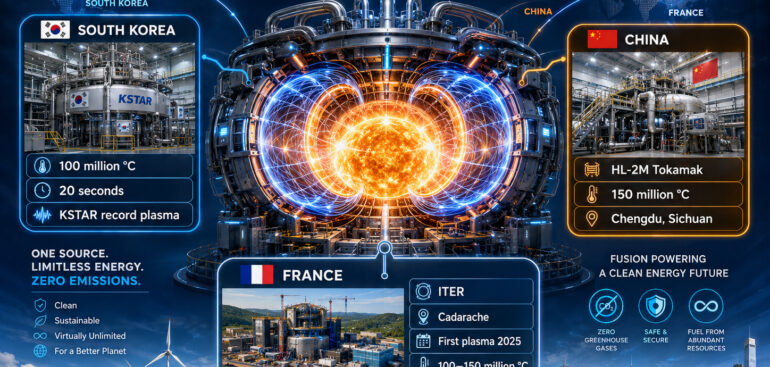
Some countries that are in this race for the development of their own artificial suns are South Korea and China. In South Korea it is developed at the Korean Center for Advanced Tokamak Superconductivity Research of the Korean Fusion Institute, with support from Seoul National University and Columbia University of the United States. On November 24, 2020, this project maintained the continuous operation of plasma with an ionic temperature of more than 100 million degrees Celsius for 20 seconds. These 20 seconds represent a record not reached by other projects.

For its part, the China National Nuclear Corporation developed the HL-2M Tokamak that operates at temperatures of 150 million degrees Celsius and is located in the city of Chengdu, within the province of Sichuan. However, this is only the largest and most stable of the artificial suns that are developed in the country.

Another country that also advances in this race is France through the International Thermonuclear Experimental Reactor that is being built in Cadarache within the European country. The development will have an estimated cost of 24,000 million euros and it is expected to obtain its first plasma by 2025. It is estimated that the temperature of this project could be between 100 and 150 million degrees Celsius.

Unlike atomic fission nuclear plants, which we addressed in the past, and which face difficulties to continue advancing and keep their costs low, the development of artificial suns that use nuclear fusion has a more promising future that could become an important piece in the competition to achieve clean, cheap and reliable energy.

This could be fundamental to achieve objective seven of the Sustainable Development Goals, which refers to achieving total coverage of electricity in the world through modern, affordable, renewable and reliable sources. A synergy that, in combination with solar, wind, hydrogen and storage developments, could be the energy pillars of a future without greenhouse gas emissions.


This article was originally published by Business Insider México.
Date: January 12, 2021
Original Link: https://businessinsider.mx/carrera-sol-artificial-paul-alejandro-sanchez-opinion-energia-circular/ [offline]
Archived Link: https://web.archive.org/web/20211027225428/https://businessinsider.mx/carrera-sol-artificial-paul-alejandro-sanchez-opinion-energia-circular/ [Archived]

Wireless Electricity


Almost any road trip in Mexico, and perhaps in the world, is accompanied by large transmission lines. Those metal poles that carry electricity from power plants at high voltage to distribution substations —where the voltage is lowered— to take electricity to our homes through concrete or wooden poles, common in our neighborhoods, or, in some cases, through underground wiring.

The principle is simple, the electricity generated in large power plants travels long distances through cables, raising and lowering the electric voltage from the production center to the consumption center depending on the consumer. In your house everything comes from the domestic wiring that gives energy to lamps, blenders, televisions, videogame consoles, sound systems; hair dryer, razor, cellphone and others. Almost any device requires energy that flows through a cable.

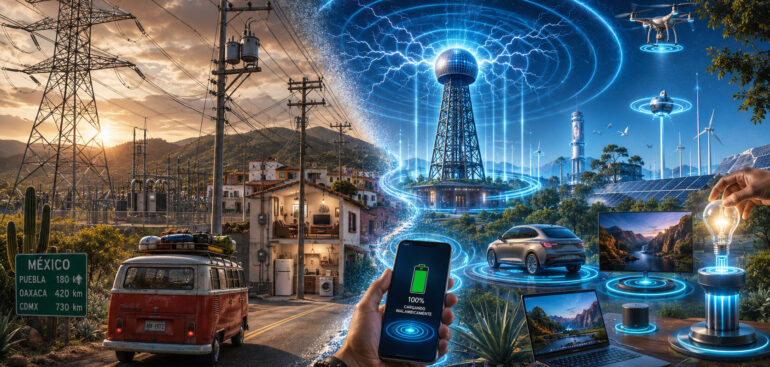
Can you imagine that in this world of electric wiring there were wireless electricity? That by holding your cellphone in your hands near an energy source, it charged without cables; that just by holding a light bulb in your hands near the energy source it turned on or, that the television did not have cables to connect.

Well then, wireless electricity is real and can be produced by transferring electricity through the magnetic field.

Since the magnetic field is used, the flow that produces the primary energy must be of high density and high frequency, of which we will speak in another column. The success of developing this technology would imply the possibility of replacing cables as the main channels of energy flow.

Wireless electricity is not something new

This, however, is not new. It was part of the efforts that the scientist Nikola Tesla promoted in the decade of 1890, more than 130 years ago. For this he developed the so-called Tesla Coil, known in English as Tesla Coil, which is a transformer composed of a series of resonant electric circuits.

In the end, Tesla did not achieve a commercial advance of importance and lost JP Morgan’s financing. Since then, some efforts to continue the development of wireless electric energy transmission have been made, in more than 100 years, with very limited advances.

Clearly, the development of wireless transmission of electricity would have many advantages. Imagine that electric automobiles could recharge at every stop or without connecting them to a power outlet. Or being able to take electricity to remote places without having to build a wide infrastructure to attend a small demand. Or, even, to take renewable energy from remote places to important consumption centers.

However, many of the problems around transmitting and distributing electricity wirelessly are not solved and the advance is rather in a conceptual stage. The important thing, perhaps, is that as technology advances this is a field with great potential for application.

For now, wireless electricity technology has some applications inside homes on a smaller scale where disruptions are smaller and environments more controlled. At least, eventually, we could forget about cables to charge cellphones and laptops and perhaps also automobiles. Without a doubt, this would be a wonderful advance.


This article was originally published by Business Insider México.
Date: December 16, 2020
Original Link: https://businessinsider.mx/electricidad-inalambrica-opinion-energia-circular-paul-alejandro-sanchez/ [offline]
Archived Link: https://web.archive.org/web/20210517193607/https://businessinsider.mx/electricidad-inalambrica-opinion-energia-circular-paul-alejandro-sanchez/ [Archived]