
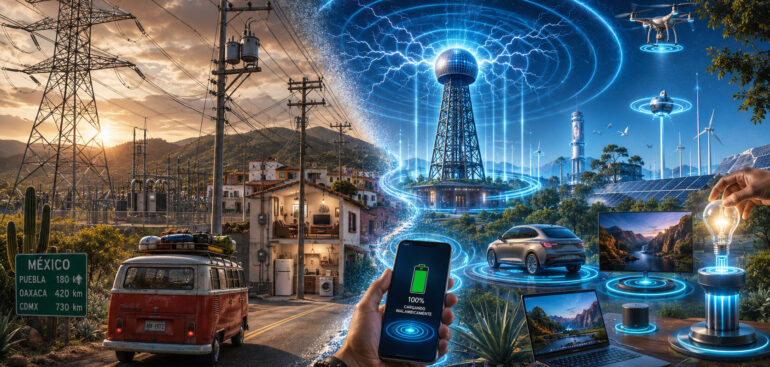
Almost any road trip in Mexico, and perhaps in the world, is accompanied by large transmission lines. Those metal poles that carry electricity from power plants at high voltage to distribution substations —where the voltage is lowered— to take electricity to our homes through concrete or wooden poles, common in our neighborhoods, or, in some cases, through underground wiring.
The principle is simple, the electricity generated in large power plants travels long distances through cables, raising and lowering the electric voltage from the production center to the consumption center depending on the consumer. In your house everything comes from the domestic wiring that gives energy to lamps, blenders, televisions, videogame consoles, sound systems; hair dryer, razor, cellphone and others. Almost any device requires energy that flows through a cable.
Can you imagine that in this world of electric wiring there were wireless electricity? That by holding your cellphone in your hands near an energy source, it charged without cables; that just by holding a light bulb in your hands near the energy source it turned on or, that the television did not have cables to connect.
Well then, wireless electricity is real and can be produced by transferring electricity through the magnetic field.
Since the magnetic field is used, the flow that produces the primary energy must be of high density and high frequency, of which we will speak in another column. The success of developing this technology would imply the possibility of replacing cables as the main channels of energy flow.
Wireless electricity is not something new
This, however, is not new. It was part of the efforts that the scientist Nikola Tesla promoted in the decade of 1890, more than 130 years ago. For this he developed the so-called Tesla Coil, known in English as Tesla Coil, which is a transformer composed of a series of resonant electric circuits.
In the end, Tesla did not achieve a commercial advance of importance and lost JP Morgan’s financing. Since then, some efforts to continue the development of wireless electric energy transmission have been made, in more than 100 years, with very limited advances.
Clearly, the development of wireless transmission of electricity would have many advantages. Imagine that electric automobiles could recharge at every stop or without connecting them to a power outlet. Or being able to take electricity to remote places without having to build a wide infrastructure to attend a small demand. Or, even, to take renewable energy from remote places to important consumption centers.
However, many of the problems around transmitting and distributing electricity wirelessly are not solved and the advance is rather in a conceptual stage. The important thing, perhaps, is that as technology advances this is a field with great potential for application.
For now, wireless electricity technology has some applications inside homes on a smaller scale where disruptions are smaller and environments more controlled. At least, eventually, we could forget about cables to charge cellphones and laptops and perhaps also automobiles. Without a doubt, this would be a wonderful advance.
This article was originally published by Business Insider México.
Date: December 16, 2020
Original Link: https://businessinsider.mx/electricidad-inalambrica-opinion-energia-circular-paul-alejandro-sanchez/ [offline]
Archived Link: https://web.archive.org/web/20210517193607/https://businessinsider.mx/electricidad-inalambrica-opinion-energia-circular-paul-alejandro-sanchez/ [Archived]