
Obesity and Climate Change


It is assumed that the more calories you consume,
the more energy you will have, but that is not the case.

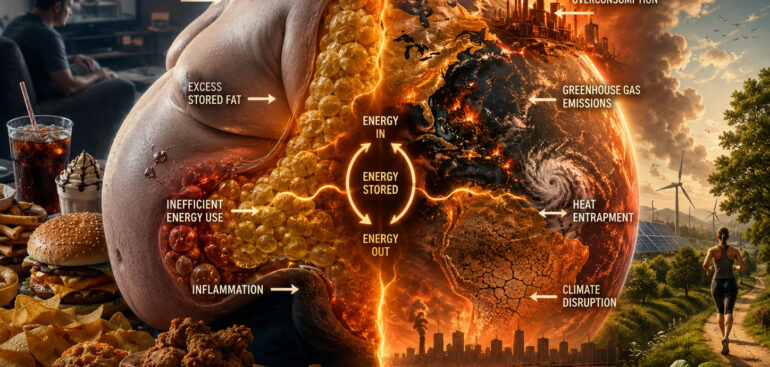
Obesity and climate change have certain parallelisms seen from the management of energy. In our times, where fossil fuels dominate the energy scene, the consumption of these sources has consequences, as we have already explored, in the emission of greenhouse gases, global warming and climate change. Now let us think of our bodies as energy systems and we will be able to observe these parallelisms.

The exploitation of fossil sources of energy is recent when we see the long course of the history of humanity, and it unleashed an increase in the quantity supplied and demanded by the economies in the world. We can think the same about the energy available to human beings; although today we can get large amounts of fats and sugars in any convenience store, before it was a matter of life or death.

Imagine societies before the Neolithic revolution, before the emergence of agriculture. Getting protein, fats and carbohydrates was not as simple as doing the grocery shopping online, but rather required dedicating time and effort to hunting and gathering, and caloric scarcity predominated. The fact that our body accumulates fat is because, in a natural state, it is very difficult to obtain and, therefore, it was important that our bodies store it, which is not very distant from the greenhouse process that allows storing the heat that our Earth receives.

By increasing the amount of food available in modern societies, today we face caloric excess that generates changes in our body and that, if it is not observed adequately, can generate overweight and obesity, which, in most cases, are synonymous with poor energy management in our organism.

Obesity has become the fifth risk factor of death in the world, since it is associated with the increase of cardiovascular, gastrointestinal, renal, obstetric, musculoskeletal, neurological, respiratory and even psychological diseases.

For their part, greenhouse gases produce an effect on the global climate, generating a significant increase in the temperature of the Earth and, this global warming, has a consequence: climate change. This forces societies to endure the consequences of a more adverse climate, the loss of microecosystems, such as some islands in the Pacific.

In such a way that more modern economies make a call to understand the impact of energy consumption on our planet in order to dissuade the trend and others create instruments such as green taxes or carbon bonds with the purpose of paying for emissions and their consequences.

In the same way, to keep the excess of calories in our bodies at bay, we have to reduce our consumption through diets that imply energy efficiency or, in some cases, pay for a gym to exercise or invest time to go out running. Even governments are beginning to adopt policies such as labeling to make consumers aware of which foods have excess fats.

So, just as climate change is associated with the abundance of fossil and cheap energy of our times that sustains the demand of economies, the obesity of our times is associated with the abundance of cheap calories that sustain the demand of our lifestyles. Nevertheless, unlike the energy sector that seeks to solve this problem through the adoption of renewable energies, a similar solution is not envisioned for us, unless we can live only from the sun and a balanced diet.


This article was originally published by Business Insider México.
Date: September 30, 2020
Original Link: https://businessinsider.mx/obesidad-cambio-climatico-paul-alejandro-sanchez-opinion-energia-circular/ [offline]
Archived Link: https://web.archive.org/web/20210515135209/https://businessinsider.mx/obesidad-cambio-climatico-paul-alejandro-sanchez-opinion-energia-circular/ [Archived]
Light Pollution


Let us position ourselves for a few minutes in the future, at a point in time where all the electric energy that is generated comes from renewable sources and where robust storage systems accompany the energy transmission and distribution networks. In that scenario, fossil sources are only used marginally in very specific cases, but the industry pales in comparison with the first decades of the twenty-first century.

The energy of this future has two characteristics: it is cheap and abundant and each additional unit does not increase the cost and, by practically not generating emissions, campaigns on energy saving have almost disappeared. It would seem that the only challenge ahead is the process of final disposal of first-generation storage technologies and solar panels that increase every year.

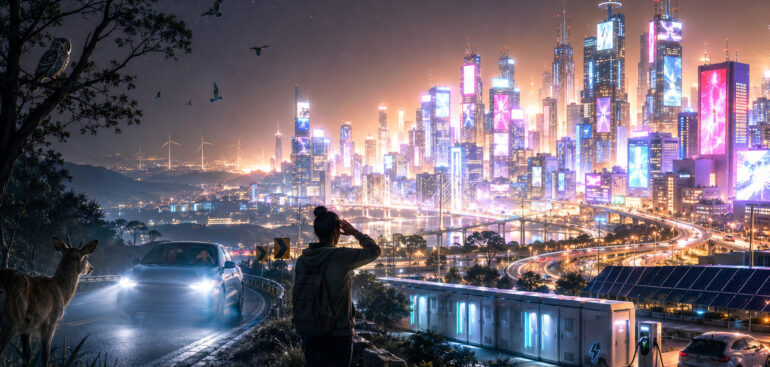
In this ideal world: can there exist a negative effect of an oversupply of clean and cheap energy? In this space I have proposed that even renewable energies could have a harmful effect on the environment if their use is not properly managed. One sample of this is light pollution, a problem increasingly palpable in modern societies.

The increase of light as a visual medium to transmit information has been possible because of two things: the low relative costs of electricity and the increase in energy efficiency in lighting technology.

In recent years, perhaps the greatest advance in energy efficiency has been in lighting. This has represented great savings for industries and businesses and has allowed more illuminated homes with less energy consumed; and it is that today an LED produces with 12 Watts light equivalent to a bulb of old that consumed 100 Watts and wasted an important part of energy in heat. This has generated savings between 80% and 90% in terms of electric consumption for lighting.

In such a way that this has allowed LED screens to be used for advertising and appear everywhere, which can have different effects on people from damage to sight to provoking epilepsies; or else they are barriers to free driving, since a strong light can provoke a decrease in the visibility of the environment.

Given this trend, it is common today to see roads, rivers, buildings, antennas and streets adorned with LED lighting, a trend that is estimated to grow in the coming years. Consequently, in our futuristic scenario, societies are destined to become permanent Broadways or Times Squares —in New York— using lighting more and more for ornamental and advertising purposes, thanks mainly to the fact that energy costs would approach zero.

Without a doubt, the question could arise: Is this something really bad? Perhaps not, if light pollution is regulated adequately to mitigate the risk as much as possible.

However, I imagine that light pollution constitutes only the tip of the iceberg of a series of problems associated with a future of cheap renewable energies without emissions. If you have any idea about it, do not hesitate to share it with me to address it more thoroughly in this space.


This article was originally published by Business Insider México.
Date: September 23, 2020
Original Link: https://businessinsider.mx/contaminacion-luminica-energia-circular-opinion-paul-alejandro-sanchez/ [offline]
Archived Link: https://web.archive.org/web/20220818205334/https://businessinsider.mx/contaminacion-luminica-energia-circular-opinion-paul-alejandro-sanchez/ [Archived]

Circular Energy


We arrive at the homonymous column of this space which, since its beginning, has proposed the idea of returning to the future in matters of energy; that is, concentrating public, private and social efforts on analyzing the challenges of the energy sector of the future and potential solutions. We have talked about energy revolutions and what the future may bring us ahead, as well as climate changes and the garbage, and the waste associated with the energy sector.

Since the seventies, the need to implement a sustainable development model has been raised, one that takes into account the use of resources and their replacement rates, in such a way that, in the future, ecosystems can provide the natural resources necessary to give a growing population the means for its continued development.

In 2015, as part of a process to expand the Millennium Goals, the countries that make up the United Nations Organization developed a series of goals related to this topic; it represents the most ambitious expression that the international community has presented, called the Sustainable Development Goals, which is constituted as part of the agenda of the international community of 2030.

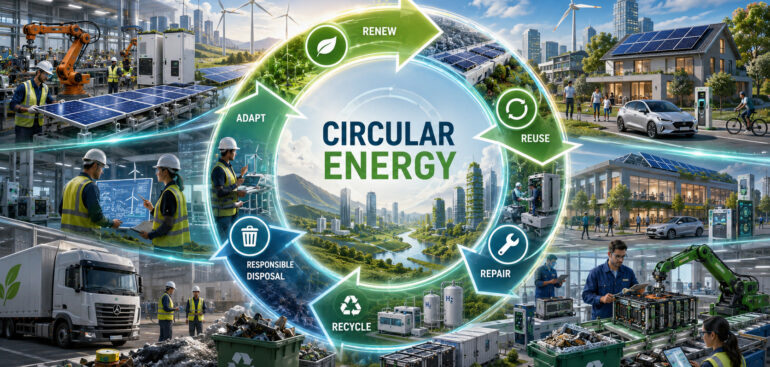
In this sense, one current that proposes an alternative solution for sustainable development is that of “circular economy.” It proposes that the international economic system can reduce waste and the intensive use of resources through the use, reuse, adaptation, repair, recycling and responsible final disposal of goods and products that form part of the supply structure that sustains the world economic base.

Given that world energy development is associated with effects on the environment and, in our times —particularly with climate change caused by greenhouse gas emissions into the atmosphere— it is key to understand how a concept such as “circular energy” can be articulated, incorporating some basic elements of the current into the energy sector.

In this way, even though the future of the energy sector is based on the development of renewable sources —such as solar and wind supported by traditional storage and electric cars, hydrogen for generation, storage or mobility, among other options— this technology needs resources and generates waste that requires special treatment.

Considering this, the challenge to overcome is how to reuse, adapt, repair, recycle or definitively and safely dispose of solar panels, traditional batteries and other clean technologies in such a way that they do not become —just as happened with cellphones and computers— digital garbage.

This is of vital importance, because one of the points established by the 2030 agenda is to guarantee universal access to affordable, reliable and modern energy services. This means that international efforts are aimed at ensuring that the inhabitants of the planet have energy; but also, that this comes from renewable sources and that they are affordable for everyone. This implies, consequently, that it is fundamental to establish mechanisms that lead to a better understanding of what is required to integrate the circular economy model into the energy sector.

This is a debate, which is still in its initial stage, and will be fundamental for the continuous development of the world and to create a green and sustainable energy sector. Otherwise, even with renewable energy sources, we could generate important impacts on the environment.


This article was originally published by Business Insider México.
Date: September 9, 2020
Original Link: https://businessinsider.mx/energia-circular-opinion-paul-sanchez-energia-futuro/ [offline]
Archived Link: https://web.archive.org/web/20240722041425/https://businessinsider.mx/energia-circular-opinion-paul-sanchez-energia-futuro/ [Archived]