
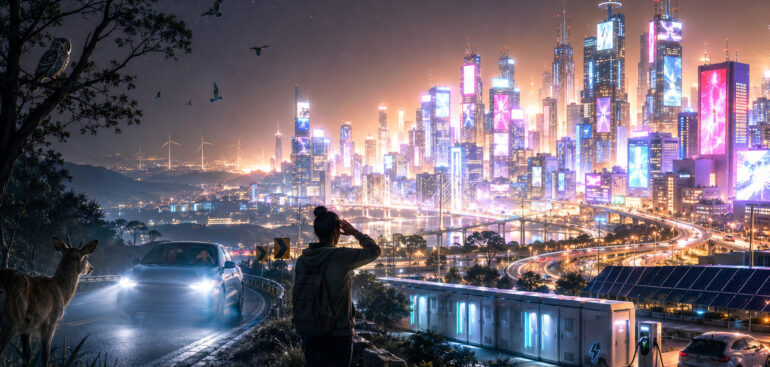
Let us position ourselves for a few minutes in the future, at a point in time where all the electric energy that is generated comes from renewable sources and where robust storage systems accompany the energy transmission and distribution networks. In that scenario, fossil sources are only used marginally in very specific cases, but the industry pales in comparison with the first decades of the twenty-first century.
The energy of this future has two characteristics: it is cheap and abundant and each additional unit does not increase the cost and, by practically not generating emissions, campaigns on energy saving have almost disappeared. It would seem that the only challenge ahead is the process of final disposal of first-generation storage technologies and solar panels that increase every year.
In this ideal world: can there exist a negative effect of an oversupply of clean and cheap energy? In this space I have proposed that even renewable energies could have a harmful effect on the environment if their use is not properly managed. One sample of this is light pollution, a problem increasingly palpable in modern societies.
The increase of light as a visual medium to transmit information has been possible because of two things: the low relative costs of electricity and the increase in energy efficiency in lighting technology.
In recent years, perhaps the greatest advance in energy efficiency has been in lighting. This has represented great savings for industries and businesses and has allowed more illuminated homes with less energy consumed; and it is that today an LED produces with 12 Watts light equivalent to a bulb of old that consumed 100 Watts and wasted an important part of energy in heat. This has generated savings between 80% and 90% in terms of electric consumption for lighting.
In such a way that this has allowed LED screens to be used for advertising and appear everywhere, which can have different effects on people from damage to sight to provoking epilepsies; or else they are barriers to free driving, since a strong light can provoke a decrease in the visibility of the environment.
Given this trend, it is common today to see roads, rivers, buildings, antennas and streets adorned with LED lighting, a trend that is estimated to grow in the coming years. Consequently, in our futuristic scenario, societies are destined to become permanent Broadways or Times Squares —in New York— using lighting more and more for ornamental and advertising purposes, thanks mainly to the fact that energy costs would approach zero.
Without a doubt, the question could arise: Is this something really bad? Perhaps not, if light pollution is regulated adequately to mitigate the risk as much as possible.
However, I imagine that light pollution constitutes only the tip of the iceberg of a series of problems associated with a future of cheap renewable energies without emissions. If you have any idea about it, do not hesitate to share it with me to address it more thoroughly in this space.
This article was originally published by Business Insider México.
Date: September 23, 2020
Original Link: https://businessinsider.mx/contaminacion-luminica-energia-circular-opinion-paul-alejandro-sanchez/ [offline]
Archived Link: https://web.archive.org/web/20220818205334/https://businessinsider.mx/contaminacion-luminica-energia-circular-opinion-paul-alejandro-sanchez/ [Archived]