

“Are You Still There?”: Why That Screen Appears When No One Is Watching the Series


More than one has done it. We are working, preparing food and we have a Netflix series or some other streaming service in the background. Sometimes we return to watch the program, but other times we continue working, talking on the phone or we even fall asleep while the series runs and runs, functioning as ambient noise. This is not uncommon, it is done a lot and more in these times of working from home. To prevent this from continuing persistently, media companies such as Netflix and YouTube implemented the “Are you still there?” button.

Of course, many of us see this button as a nuisance after the fourth or fifth chapter of your favorite series, when you want to see what happened with the plot after the previous episode. But why is it important? And, above all, what does it have to do with energy, the topic we address in this space.

This button exists because if it were not so, we would surely leave the television on ad infinitum. When we addressed the topic of light pollution, we concluded that when the consumption of an additional unit of something does not generate a cost for you, or the cost is not perceived in the short term, the consumer will tend to increase their consumption. But the fact that it does not cost you does not mean that it does not cost YouTube or Netflix for the series to run while you fall asleep.

This is because the series of these platforms rest on servers that require energy to be available at all times. And, the greater the intensity of consumption, the more intensity of processing is generated, which requires more energy, on the one hand —because the server is in active operation all the time—; on the other hand, because they generate heat that requires more energy to keep the rooms where said servers are cold.

In recent years two phenomena have occurred; the first, the energy consumption of the cloud, that is, the servers of data companies such as Google, Microsoft, Netflix; Amazon and Dropbox, among others, has increased. Nevertheless, the second effect is that energy consumption has become more efficient per unit of work performed. This means that every day more energy is consumed to maintain digital services in the cloud, although much progress has been made in energy efficiency.

In that sense, the idea behind the “Are you still there?” button is not because Netflix cares about you, it is a measure of consumption efficiency and, at the end of the day, of energy efficiency. This is because if all of us left series running all the time, surely the company’s energy consumption would increase.

But not only that, greenhouse gas emissions would also increase, both those that you cause through the consumption of your series at home, and those of the company for keeping its servers operating in an inefficient way while no one is watching TV. We will go deeper into that next week.

However, not everything is bad, this could also be good for you. Because to the extent that you are more conscious of your energy consumption at home, you will avoid surprises in your electricity bill every two months, with which you save electricity and contribute to mitigating climate change.

So remember, if you have the habit of waiting until the server asks you “Are you still there?” and you are really not paying attention to the series that runs incessantly, perhaps it is time to rethink your energy consumption for the good of the planet and of your pocket.


This article was originally published by Business Insider México.
Date: November 11, 2020
Original Link: https://businessinsider.mx/sigues-ahi-boton-ver-series-netflix-streaming-opinion-energia-circular/ [offline]
Archived Link: https://web.archive.org/web/20211204081743/https://businessinsider.mx/sigues-ahi-boton-ver-series-netflix-streaming-opinion-energia-circular/ [Archived]
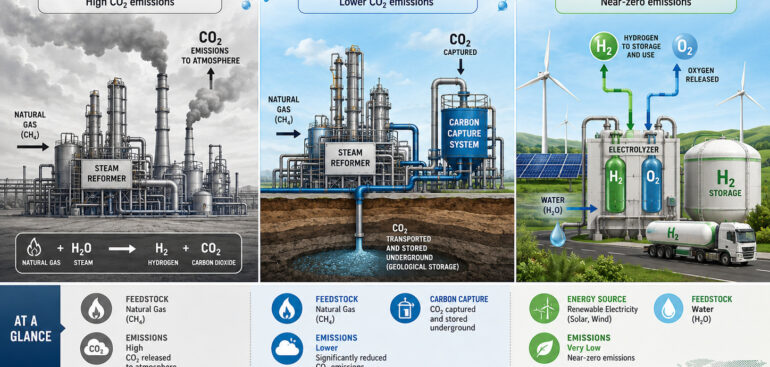

Gray, Blue and Green Hydrogen


You read here first, a few months ago, that the hydrogen fever would begin in the world. From then to date we have heard notes such as Airbus’s bet to develop a zero-carbon-emissions airplane powered by hydrogen; using natural gas transportation and distribution pipelines to distribute hydrogen to industries, businesses and homes in the United Kingdom and the development of cargo transportation schemes that use hydrogen as a primary source of energy. Even the promotion of a National Hydrogen Association.

Surely hydrogen will continue giving something to talk about in the future and surely this column will continue following up on it. On this occasion, given the interest it has awakened, I want to touch on the three hydrogen production processes. To make the distinction simpler we can talk about gray hydrogen, blue hydrogen and green hydrogen.

Gray Hydrogen

Gray hydrogen is that which is obtained from a process known as steam reforming using natural gas. Through a chemical reaction of methane with water, hydrogen and carbon monoxide are obtained.

Although it uses natural gas, given the greenhouse gas emissions, it is not considered in itself a clean technology. This is the dominant technology for hydrogen production in the world.

It is worth highlighting that when this process is used with coal it is considered brown hydrogen, but we will not analyze this for the moment.

Blue Hydrogen

For its part, blue hydrogen uses the same steam reforming process; however, it sequesters 90% of greenhouse gas emissions and stores them underground.

Since the production process is considered low in greenhouse gas emissions, it has been called low-carbon-emissions hydrogen. However, this process is costly, which has limited its adoption compared with gray or brown hydrogen.

Green Hydrogen

Lastly, green hydrogen is that which is obtained through the electrolysis process; it consists of using electricity to separate water molecules into hydrogen and oxygen.

Although this can be done with any source of electricity —from the grid, combined cycle or nuclear—, green hydrogen is considered to be that process that uses renewable energy sources such as photovoltaic solar and wind as the exclusive energy source for the electrolysis process.

Technological developments at the moment do not discriminate among the ways of producing gray, blue or green hydrogen, and concentrate on its usefulness to replace fossil sources of energy in industrial, commercial and residential processes; however, it is expected that in the future green hydrogen will be developed with greater intensity, particularly in places with intensive processes of renewable energy generation such as the coasts of the United Kingdom.

Implementing hydrogen in Mexico is a process that will require much evaluation and investments. Although we are closer to the development of gray hydrogen due to the abundant natural gas from the United States, the country has great potential to develop green hydrogen; skipping the phase of blue hydrogen and preparing for a future where it does not depend on energy inputs from abroad. That would be a decisive step for the country to consolidate its energy security.


This article was originally published by Business Insider México.
Date: November 4, 2020
Original Link: https://businessinsider.mx/hidrogeno-gris-azul-verde-opinion-energia-circular-paul-alejandro-sanchez/ [offline]
Archived Link: https://web.archive.org/web/20240413040223/https://businessinsider.mx/hidrogeno-gris-azul-verde-opinion-energia-circular-paul-alejandro-sanchez/ [Archived]

A Zero-Emissions Airplane


The transition to hydrogen will require the decisive action of the entire aviation ecosystem.

– Guillaume Faury

Let us take for granted, at least for the duration of this column, that the problem of urban-land mobility and its relationship with the use of fossil fuels is solved with the adoption of massive electromobility solutions that use renewable sources and storage. But how do we solve the problem of air and maritime transport? It seems that the answer is found in hydrogen.

For that reason, on this occasion we will focus on the recently announced hydrogen airplane that is under development by Airbus, with the idea of being launched in 2030.

This is the industry’s response to other alternatives that are not so viable at this moment of technological development, such as electric and solar airplanes and airplanes that use liquefied natural gas. Regarding the first ones, the problem is found precisely in the batteries and does not have to do with storage capacity, but rather with the amount of power they can release.

A conventional passenger airplane, for example the Boeing 737, would require a battery that could store and release more energy per unit of mass than what is available at this moment, without considering that the cost is too high to be competitive.

On the other hand, natural gas would seem to be an option that combines low prices, considering that the shale gas revolution in the United States has produced the cheapest natural gas in the world with high availability and lower greenhouse gas emissions compared with jet fuel.

The problem with natural gas as a replacement fuel is that it has lower calorific power than kerosene; in order to be used, it would have to be liquefied natural gas, which requires investments and modifications to the existing infrastructure; furthermore, since its density will be lower, it would require doubling the weight of the fuel to maintain the same travel distance. In sum, development in that area has remained for small airplanes and local trips.

Considering this, the countries that are lined up in the development of the technologies that will define the future of energy see in hydrogen a possibility to transition toward airplanes with almost zero emissions and that could even be silent machines.

The concept is under development by Airbus and it is expected that it may be achieved by 2030, but the technology also has its challenges. The main one is discovering how to store liquid hydrogen during flight at very low temperatures and avoid the risks of the volatile fuel. However, in case of success, it would open a world of possibilities that could revolutionize the air transport industry and decrease the use of fossil sources.

As we pointed out some months ago, this may represent one of the most important applications within the hydrogen fever that motivates the most advanced research centers to take advantage of the opportunities to develop alternatives to continue with the advance of the energy transition even in the most difficult sectors such as aviation.

Ten years seem like a lot, but in scientific development and technological innovation it is a relatively short time that can charge us the bill as a country. With this panorama in mind, a public policy to promote science and technology for the energy sector was never more necessary. That would be a firm step toward true energy sovereignty sustained in the future and not in the old glories of the past.


This article was originally published by Business Insider México.
Date: October 7, 2020
Original Link: https://businessinsider.mx/avion-cero-emisiones-opinion-paul-sanchez-energia-circular/ [offline]
Archived Link: https://web.archive.org/web/20210515142831/https://businessinsider.mx/avion-cero-emisiones-opinion-paul-sanchez-energia-circular/ [Archived]