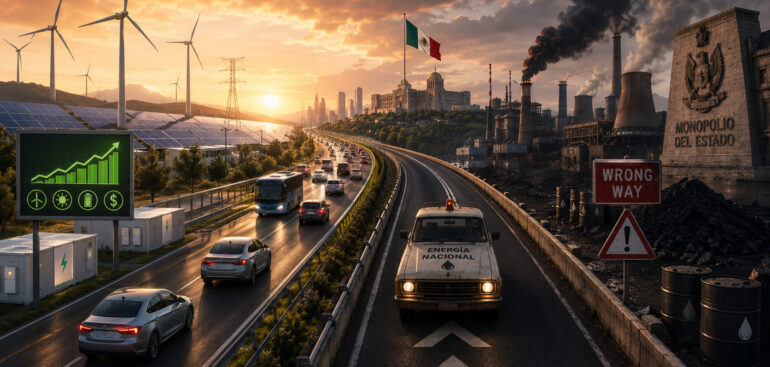
If on a highway all cars are coming in the opposite direction, we probably have to reflect on whether our car is not the one going backwards. In our national energy sector, it is evident that we need to stop and reflect on why we are going in a different direction from the rest of the world.
But first, it is true that we interrupt our usual programming, and I do not forget that we still have pending to talk about dark energy in the universe, the continuation of our previous installment, to talk about more banal topics but that are of great interest to all Mexicans in our day to day: the future of the national electric industry that is about to be defined, at least for the next four years.
This first of February, holiday due to the advance of the 104th anniversary of the Day of the Promulgation of the Political Constitution of the United Mexican States of 1917, the news woke us early, as has been customary, that on Friday the 29th the President of the Republic signed and delivered to the Congress of the Union a preferential initiative to modify the Electric Industry Law.
This is the most recent of a series of attempts that the federal government has made to return the electric sector to a state not only prior to the energy reform, but further back, to 1960 when then-president José Adolfo Mateos nationalized the entire electric industry to turn it into a monopoly operated by a state company, the Federal Electricity Commission (CFE).
In fact, in December 2019, CFE presented a list of demands that outlined this plan and that began with modest actions and omissions, particularly by the Energy Regulatory Commission (CRE) and the National Energy Control Center (Cenace), so that CFE would have a “level playing field,” a euphemism with which it is intended to return to the monopoly. Needless to say, currently, the state company controls more than 80% of the country’s electric generation, more than 80% of consumers; enjoys the monopoly of transmission and distribution, has one of the most important gas pipeline networks in Mexico and receives direct capital injections from the Mexican government.
In times of poor economic performance —in part because of the COVID-19 effect on our lives and because of a series of economic decisions of the current federal administration—, where countries seek to stimulate businesses and companies through support for spending on electric energy; where economic recovery is sought, attracting investment and generating jobs, and where it is sought to paint it as a green recovery, the actions derived from this preferential initiative place us in the opposite direction of the world.
The probability that this course of action will lead us to an imminent collision with other automobiles (countries) or that we come out with permanent damage (loss of competitiveness and country credibility) is high. On the one hand, the statement of reasons clearly dictates, without euphemisms, that the reform to the Electric Industry Law is carried out to strengthen CFE. This goes against the principle of free competition and free concurrence protected in constitutional article 28. Since 2013, generation and commercialization were removed as exclusive monopolies of the State in the Magna Carta to be considered economic activities under the regime of free competition.
Faced with a practice that violates the principles of economic competition that strengthen a State company, we could not rule out that American and Canadian companies are planning to take this issue to a controversy within the T-MEC. With a new government in the United States that actively promotes global decarbonization and the energy transition, then a crash is imminent caused by a vehicle, Mexico, that goes in the opposite direction, thinking that all the others are going in the opposite direction.
The problem is that not only has the driver not realized it, but he thinks that everyone else is the one going backwards. We return to our usual programming next week.
This article was originally published by Business Insider México.
Date: February 3, 2021
Original Link: https://businessinsider.mx/sentido-contrario-cfe-reforma-ley-industria-electica-paul-alejandro-sanchez/ [offline]
Archived Link: https://web.archive.org/web/20221205005654/https://businessinsider.mx/sentido-contrario-cfe-reforma-ley-industria-electica-paul-alejandro-sanchez/ [Archived]