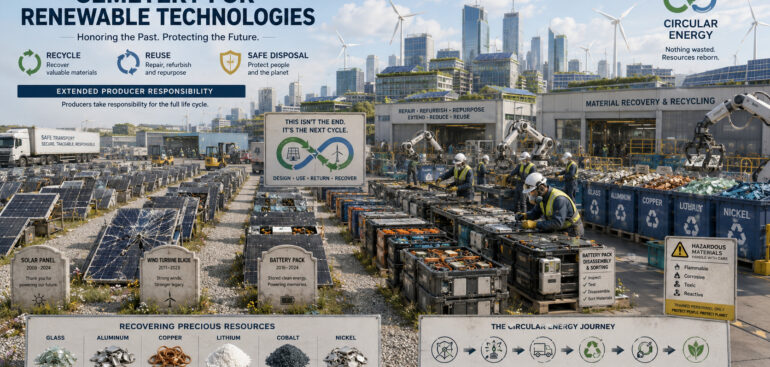
I shared with you in a previous installment that the waste of the future has to do with the technology that is used. Just as today we see dumps of tires or technological waste —such as computers and cellphones—, in the future we could be witnesses of dumps of solar panels and batteries. If this is a possibility, then, should we not be planning a cemetery for renewable technologies with the purpose of conducting them in an appropriate and sustainable way to their final resting place?
It is expected that in the coming years there will be a boom regarding distributed generation on rooftops. For example, San Francisco has already passed a law that prevents new residential constructions from using fossil fuels. If this trend continues, the solar panels and batteries that will be part of the everyday landscape of the future must be disposed of responsibly.
This cemetery of renewable technologies is not a conventional dump; because it requires a recycling and treatment process to, first, reuse the greatest possible part of the discarded materials; second, to dispose of in a sustainable and adequate way the waste that can have a negative impact on the soil and the environment.
Regarding solar panels, conventionally more than 75% of these is glass that can be recycled without much problem; 10% is plastic, 10% metals and 5% silicon. Perhaps the greatest value of recycled panels is the metals, which are mainly aluminum, silver and copper. Although aluminum is easy to extract, silver and copper require more complex chemical processes that can reduce the recovery of plastic and glass.
Batteries, for their part, can have a somewhat more complicated process because, although they have iron, aluminum, plastic and copper, there are also chemicals in liquid state of lithium, nickel, cobalt and other substances. The final disposal of batteries is more complex than that of solar panels since the cells represent chemical risk that can derive in fires and burns; poisoning by toxic substances in the environment and causing cancer.
In this way, the cemetery for batteries must be much more careful since the greatest part of the materials must be recovered through physical, chemical separation and by means of heat; subsequently, safely storing those substances that represent risks to the health and safety of communities.
The recycling and final disposal of renewable technologies, due to their complexities, is not a cheap process. Despite this, it is rarely considered in the budgets of installers, leaving under the protection of the final consumer the responsibility of replacing and safely disposing of these components.
This, at the end of the useful life of the technology, would represent a cost not considered at the moment when the renewable solution was budgeted. In this sense, the real savings would be adjusted downward and in a single exhibition, which would imply allocating more resources for the removal and disposal of the technology.
For these reasons, in Europe the extended responsibility of the producer has been promoted, which requires all producers to consider in their prices and within their responsibilities the removal of solar panels and batteries that are installed in homes, businesses and other buildings; with the purpose that the final cost also reflects the cost of getting rid of these technologies when their useful life ends. In Mexico, we are still in time to promote the extended responsibility of the producer and the minimum standards to dispose of renewable technologies —this cemetery for renewable technologies—, before it becomes a public problem that gets out of our hands. At the end of the day this is the principle of circular energy.
This article was originally published by Business Insider México.
Date: November 25, 2020
Original Link: https://businessinsider.mx/cementerio-tecnologias-renovables-opinion-paul-alejandro-sanchez-energia-circular/ [offline]
Archived Link: https://web.archive.org/web/20211023143433/https://businessinsider.mx/cementerio-tecnologias-renovables-opinion-paul-alejandro-sanchez-energia-circular/ [Archived]