
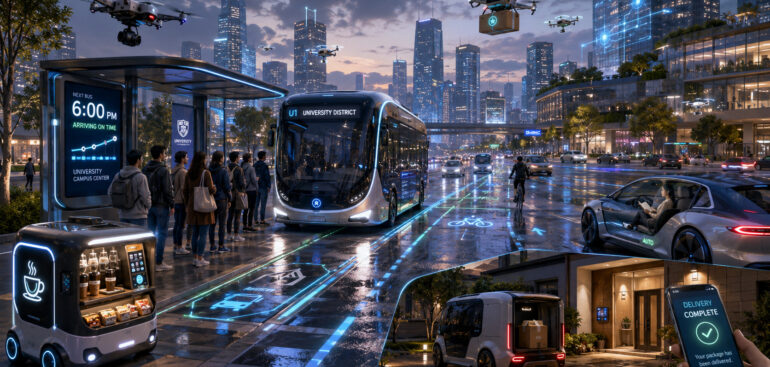
It is 5:59 in the afternoon, in the middle of rush hour and it is raining. Juan waits for the bus at the designated stop, near his university; there is a line of people waiting. The board announces that the next bus will arrive at 6:00 in the afternoon. Exactly at the designated time, the transport arrives.
When the door opens there is no one at the entrance, only a series of systems integrated with processors, screens, sensors and cameras. To enter you pass a card that gives you your balance; if you have no balance you get off voluntarily, otherwise, the system will send an alarm and you could be admonished at the next stop.
Before, in 2021, it would have taken two hours by bus to get home. Now it takes only one hour. There are no longer traffic lights on the route; the road sensors are interconnected with each bus and each automobile that circulates. In the past, a large part of traffic jams occurred for three reasons: automobile accidents, not respecting traffic signs and a lack of road culture.
Traffic is organized by times. The interconnected systems use algorithms and plan in real time; they send stop and go signals directly to the automobiles, which process the instructions considering the central instructions, the cars around them, cyclists, pedestrians and obstructions on the road.
People have more time because traffic operates efficiently and buses arrive at the established time with a maximum tolerance of 5 minutes. The systems are also connected with other routes and the metro, so that trips can be organized and connected in several segments in an optimal way.
Elsewhere, Adriana left her office and the GPS indicates that it will take two hours to reach your destination. She is reading that book that was added at the beginning of the year to her resolutions and she is already halfway through, reading one hour daily on average, every day in traffic. She is in a taxi, but there is no one driving, the automobile is a unit that is interconnected to the company’s central system and in turn is communicated with the traffic control system from the central offices of the government.
Traffic control is very important, and not only land traffic control, but also air traffic control. Since the massive proliferation of drones a few decades ago, it is now common to see drones everywhere, from those that take photography and videos, to those that monitor traffic, without forgetting service drones that are dedicated to sending packages, making repairs on roofs and facades, fumigating and many other activities.
On the street, Javier sees in the distance a mobile autonomous business coming. An intelligent vending car that sells anything without the need for an operator or seller. This one sells coffee as if it were an old vending machine but that moves analyzing the mobility patterns of pedestrians. It is not the only thing, food, books, flowers, water, clothing, almost anything.
At her house, Laura receives a message, a package has arrived, but there is no one in the cargo truck; and it is that parcel services and food deliveries have also benefited greatly from light cargo autonomous vehicles that send their location in real time and that make deliveries automatically without any operator or delivery person, in addition to aerial delivery by drones.
We say goodbye to this quick visit to a possible future and, perhaps, not very far away. I hope that you, reader, have found this fantastic journey as entertaining as I have, and it is that the future is built first in our imagination.
This article was originally published by Business Insider México.
Date: February 16, 2021
Original Link: https://businessinsider.mx/futuro-movilidad-inteligente-opinion-energia-circular-paul-alejandro-sanchez/ [offline]
Archived Link: https://web.archive.org/web/20240522143337/https://businessinsider.mx/futuro-movilidad-inteligente-opinion-energia-circular-paul-alejandro-sanchez/ [Archived]