
With this installment we finish the trilogy of waste and refuse related to the energy sector and dominant technologies. Two weeks ago we entered into the public crisis generated by horse waste —urine, manure and corpses— in the great cities of the late nineteenth century and early twentieth century; and the previous week, we analyzed how the growth in the use of fossil fuels in the world has produced an increase in greenhouse gas emissions related to climate change.
The problem caused by horse waste was solved when the automobile became widespread and the use of fossil fuels increased as the main source of transportation in the world. In the near future, the use of fossil sources could be replaced by the generation and storage of renewables, but that could also bring with it the energy waste of the future.
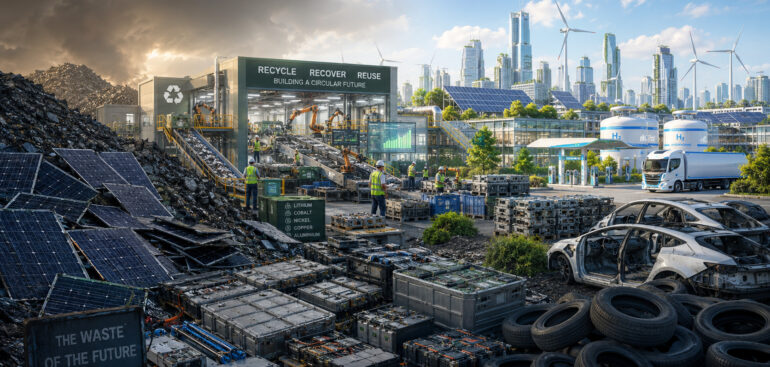
When the moment arrives, the proliferation of solar panels and batteries will be of such magnitude that, just like the horse in its time or greenhouse gas emissions, their final disposal can be a public problem of great importance.
Tons of waste of the future
Those solar panels that have been installed in recent years and those that are about to be installed could add up, by 2040, to 770,000 tons. This figure will increase as the roofs of the world become covered with solar panels; something that could be relatively fast, considering that the most important cities in the world have already begun to develop policies so that new constructions take advantage of their roofs to generate electric energy.
On the other hand, reaching the energy potential that renewable energies can release requires the development of storage on a large and small scale; this is batteries in generation plants, but also in buildings, businesses, industrial parks and homes.
Although there are many technological developments in the research and maturation stage, today conventional storage is carried out through lithium batteries that contain nickel, cobalt, aluminum, manganese and other components; in such a way that the batteries for cars and the electric sector that have been developed until now, and those that continue in the near future, can represent close to 7.8 million tons per year by 2040.
Given that one of the main costs of an electric car is the battery and its replacement can mean more expense —in terms of leveled investment— than buying another car, it is highly probable that the waste will not only be the batteries but the entire frame of the automobile, in addition to the fact that other legacy waste is not eliminated, such as tires.
A solution for the waste of the future
To solve these problems of the near future, two elements are required working jointly and in synergy:
- Policies for the final disposal of this waste in the present that responsibly address withdrawal in the future. That is, the responsibility of the producer and consumer must be extended in the present, in order to have the means of recycling, disposal and reuse in the future.
- Innovation and development to increase the useful life of technology and transition toward better methods of generation and storage of energy and transportation.
Who knows, perhaps another energy transition, there in the distant future, will allow us to change from solar generation, conventional storage and electric cars to a system based on hydrogen as an energy vector, storage and transportation. There is still a long way to go, but without a doubt, the energy future of the world will be surprising.
This article was originally published by Business Insider México.
Date: August 26, 2020
Original Link: https://businessinsider.mx/opinion-la-basura-del-futuro-paul-sanchez-columna-energia-circular/ [offline]
Archived Link: https://web.archive.org/web/20220928192656/https://businessinsider.mx/opinion-la-basura-del-futuro-paul-sanchez-columna-energia-circular/ [Archived]