
“This century can credibly be called the century of decarbonization”
-Angela Merkel
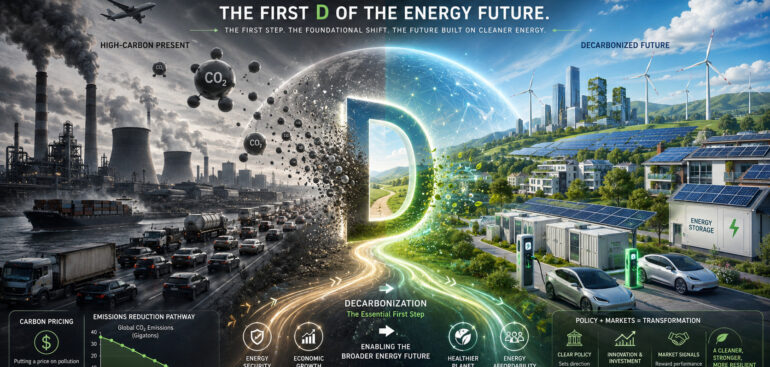
This week we begin with the first installment of a four-part series called “the Ds of the energy future,” namely: decarbonization, digitalization, decentralization and democratization. To begin, we touch on the topic of decarbonization, which is one of the social demands that has gained the most strength in recent years.
Decarbonization refers to the process of eliminating the sources of greenhouse gas emissions in economies which, for simplification, is measured in equivalent carbon dioxide. In such a way that the words coal or carbon, in this sense, are used as a reference to this.
The task is not simple, since it is necessary to advance in means of transport that use renewable sources of energy, where the main challenge is found in aircraft and large vessels; as well as in energy efficiency in buildings, electronic devices and industrial processes; and, of course, in the generation of electric energy.
Said in another way, decarbonization would be the most important result of a deep energy transition where the use of fossil sources of energy is eliminated, or at least reduced to the strictly necessary minimum. The challenge is enormous, however, it is already part of the international agenda contained in the Paris Agreement.
In matters of electric energy generation, renewable technologies, particularly solar and wind, have reduced their costs rapidly in the last 10 years. With low technological costs, the proliferation of renewable projects has accelerated throughout the world. Large-scale projects, whether wind, onshore and offshore, as well as large solar farms, have appeared on all continents.
But it has not stopped there. On a small scale, in those places where projects have found fertile ground, roofs have been covered with photovoltaic panels for distributed energy generation, which allows users of more basic markets to save on their energy bills and reduce greenhouse gas emissions, while in more advanced markets, they can charge their electric cars, store energy and sell energy to the grid or to their neighbors.
Nevertheless, to continue advancing in the correct direction of decarbonization, it is necessary to advance in the technological development of new-generation batteries that can store the energy generated by renewable sources and permanently exorcise the ghost of intermittency.
Medium- and long-term decarbonization policies include, in addition to incentives to use renewable sources and reduce greenhouse gas emissions in production, the penalization for emissions in energy consumption. In some countries, advanced carbon bond markets have already been developed where one must pay or compensate for the emissions directly related to their energy consumption; whether in fuels such as coal, gasoline and natural gas; or in electricity, depending on the energy mix that was used for its generation.
Finally, decarbonization in the global energy future will be complemented by other elements such as digitalization, decentralization and democratization, which together generate positive feedback among each of them for the benefit of all the citizens of the world. We will talk about these in the following columns. Until then.
This article was originally published by Business Insider México.
Date: July 15, 2020
Original Link: https://businessinsider.mx/descarbonizacion-futuro-energetico-energia-circular-paul-alejandro-sanchez-opinion/ [offline]
Archived Link: No server is available to handle this request. [Archived]