I buy everything from ACME, they are the company I trust the most.
– Wile E. Coyote
A fundamental aspect of the centralization that characterizes the electric sector lies in the maxim that says: “the bigger, the better.” For example, the bigger a generation plant is, the cheaper the energy is and therefore investment is made to take it from the distant production centers to the consumption centers. Right?
According to the logic of electric centralization, few large companies are required to make all the investments in generation and also in transmission and distribution lines to take energy to consumption centers. In such a way that production is centralized in vertically or horizontally integrated companies.
To illustrate the above, do you remember the Coyote from the “Looney Tunes” animated series? Created in 1949 with his co-star the Road Runner, in more than 70 years of life he has dedicated himself to the fruitless task of hunting the fast bird. For this he has used products from the ACME company, on which I will stop a little.
The ACME company is an acronym that means, translated into Spanish, “A Company that Makes Everything” and was the clear reflection of the companies of the 1950s. General Electric, for example, made the same irons, stoves, toasters, televisions, refrigerators; garbage burners, coal stoves, jet turbines and, in a futuristic vision, electric cars and their home chargers, to which we will dedicate an article later.
ACME, like GE, like the electric companies of old — known as utilities —, are part of that type of organization. However, since the 1970s this model entered into crisis and was replaced by smaller and more dynamic companies, reducing competitiveness to the large ACMEs. Eventually companies such as GE or the electric utilities began divesting assets and less competitive business branches.
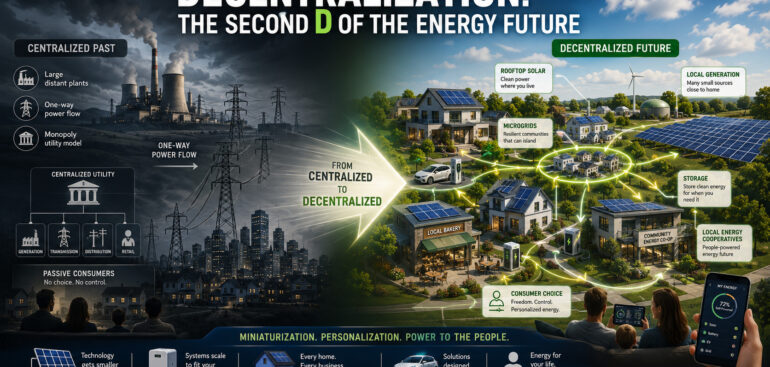
If technological advance has taught us anything, it is the importance of miniaturization, individualization and personalization of products and services. Where before there was a landline telephone, now there is a smartphone for each member of the family. Why should it be different in the electric sector?
Smaller and more flexible plants are cheaper and easier to operate, they can be located near large consumption centers and, therefore, be more competitive than the large plants of old, and among these are solar plants. The development of small solar plants between 0.5 MW and up to 10 MW has grown everywhere in the world under that logic and has lowered the costs of electric energy in the most sophisticated markets.
But it does not end there. What is closer to the consumer than generating on their own roofs? The growth of solar panels on the roofs of residential, commercial, industrial users and even government offices has grown in those markets where regulation is more favorable, for example, California.
The energy future outlines a true trend of decentralization, users who take control of their consumption and require, increasingly less, energy from large production centers, cooperatives that create microgrids for self-consumption or entrepreneurs who use their land to sell energy near the cities.
And this is only the beginning, when electricity storage is economically viable, an important part of consumers will use increasingly less energy coming from large power plants.
Electric decentralization is synonymous with freedom and energy independence of consumers and goes hand in hand with the decarbonization of the sector. Undoubtedly, it will be a reality sooner rather than later.
This article was originally published by Business Insider México.
Date: July 22, 2020
Original Link: https://businessinsider.mx/descentralizacion-sector-electrico-energia-circular-paul-sanchez-opinion/ [offline]
Archived Link: https://web.archive.org/web/20210303081030/https://businessinsider.mx/descentralizacion-sector-electrico-energia-circular-paul-sanchez-opinion/ [Archived]